
CEN has published a revision of EN12221: 2026 Child care articles - Changing units and changing pads for domestic use - Safety requirements and test methods.
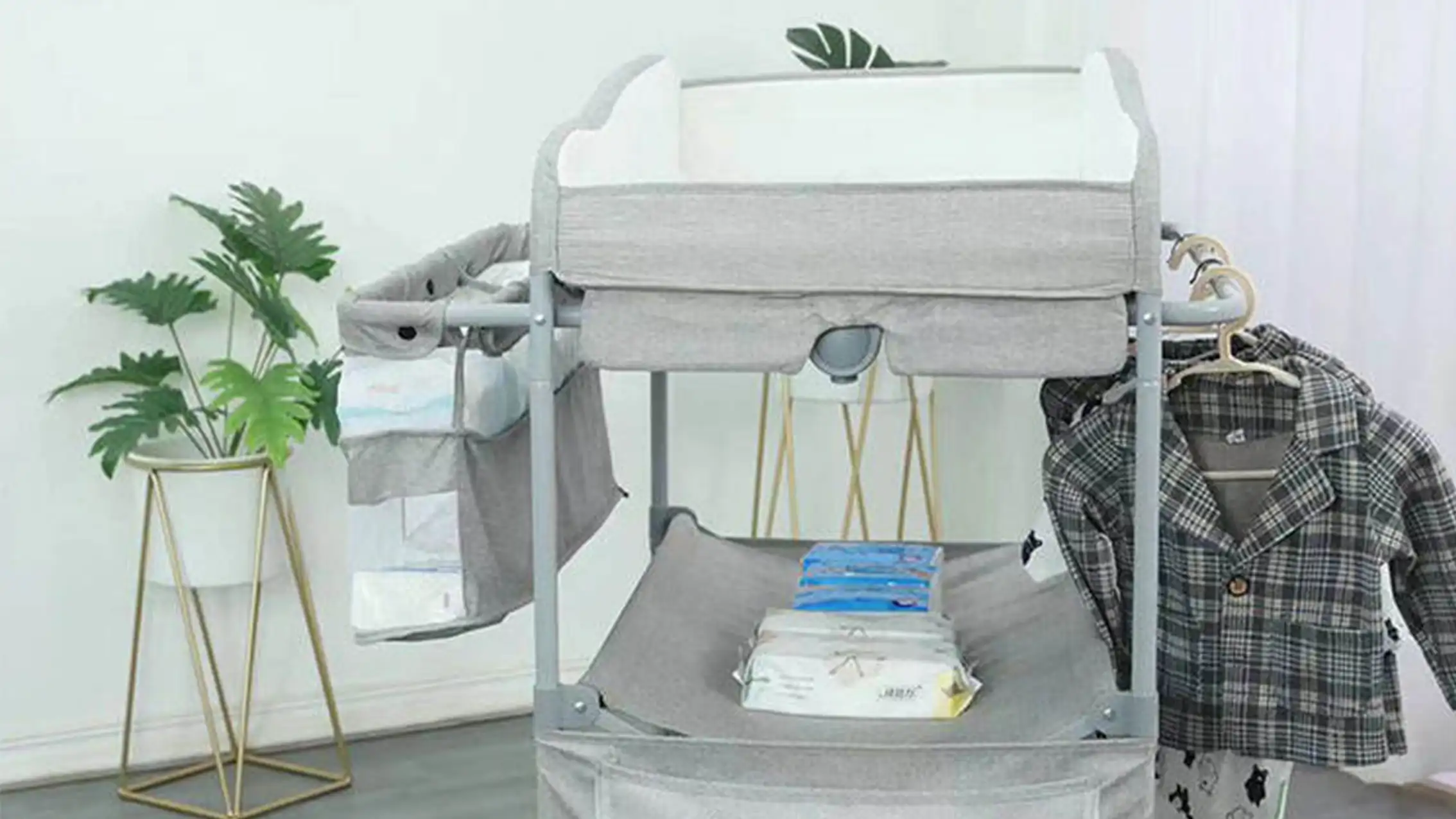
The EN 12221 standard relating to changing units has been revised. The latest version has now been made available by CEN and is dated March 2026.
What is EN 12221?
EN 12221 is the CEN European standard for child care articles - changing units and changing pads for domestic use.
EN 12221 specifies safety requirements and test methods for changing units, changing pads and changing unit accessories for domestic use:
- Mechanical safety:
- Entrapment, moving parts, folding hazards, stability, structural integrity and fall prevention.
- Specific test equipment and probes (e.g., finger entrapment probes of 7 mm and 12 mm).
- Stability and loading tests using defined test masses:
- Test mass A - rigid cylinder Ø160 mm × 300 mm, mass ≈ 9 kg.
- Test mass B - rigid cylinder Ø200 mm × 300 mm, mass ≈ 15 kg.
- Small parts assessment (small parts cylinder) and feeler gauge use (0.4 mm thickness) for gap checks.
- Chemical and thermal hazards:
- Migration limits and formaldehyde evaluation referenced to EN toy and textile methods.
- Thermal exposure tests to assess hot surfaces or adjacent heating risks.
- Durability and accessibility: requirements for filling materials, repeated use, locking mechanisms and operation devices.
- Product information: marking, purchase information and instructions for safe use; inclusion of specific symbols.
- Test methods & annexes: detailed test rigs, test floors/walls, rationales and relationship to EU safety directives.
Which products are covered by EN 12221?
The scope of the standard includes changing units, changing pads and changing unit accessories intended to be used in conjunction with other items, such as cots or dressers.
What are the changes introduced by the revision?
The most notable development is the extension of the standards’ scope to include changing pads, regardless of whether they are supplied with the changing unit or provided separately.
Compared with the previous edition of the standard, the main technical changes are as follows:
- Parts 1 and 2 of the standard have been merged into a single document and reorganised using a hazard-based approach, improving overall readability and comprehension
- Terms and definitions, as well as requirements related to chemical, thermal and mechanical hazards, have been revised to reflect the current understanding
- New durability and strength requirements have been introduced, including accessibility to filling materials (seam and weld strength) and the durability of the changing unit
- Product information has been enhanced and new symbols added to provide users with clearer and safer guidance
Why are changing pads now included?
Until now, changing pads not provided with a changing unit were not addressed by any dedicated standard in this context. This created a regulatory gap: certain pads, particularly those with raised sides, may give a perception of safety (cocoon effect), while their actual performance in use – especially when placed on an elevated changing surface – may expose additional risks if stability or retention is insufficient.
The revision of EN 12221 brings clarity to this situation by defining the scope more precisely: some changing pads are now explicitly covered by the standard and are therefore subject to new requirements and test methods.
Which changing pads are concerned?
The revision targets changing pads with raised sides or edges, i.e. those that visually delimit a space and may suggest that the child is more securely retained. Thin flat pads without raised sides remain outside the scope of the standard. The intent is to focus on products where the perception of safety created by raised sides could mask insufficient real‑world performance.
How is compliance assessed?
The revision aims to objectify safety through reproducible tests, dimensional criteria and measurable results.
The proposed changes include:
- Dimensional requirements depending on pad design and side configuration;associated with product information to ensure adequation of the changing pad with the changing unit for which it is suitable
- Key mechanical/functional test designed to simulate a slipping scenario and assess retention capacity