
According to the BBC, temperatures broke June records in Germany, Belgium and the Netherlands, while prolonged heatwaves in Spain and France continued to drive up demand for cooling solutions. As a result, leading Chinese air conditioner manufacturers are working around the clock to meet the surge in global orders for air conditioning products.
China exported $27.2 billion worth of air conditioners in 2025, accounting for nearly 40 percent of global exports, according to OEC data. As China continues to play a leading role in the global air conditioning supply chain, maintaining consistent product quality has become more critical than ever.
Comprehensive air conditioner quality control inspection helps manufacturers and importers identify defects before shipment, ensure compliance with international safety standards, and deliver reliable products to overseas markets.
Air Conditioner Safety Standards
When sourcing air conditioners, compliance with safety and energy efficiency regulations is critical for entering international markets. Below is a breakdown of the primary Air Conditioner Safety Standards categorized by major countries and regions.
International Air Conditioner Safety Standards
The International Electrotechnical Commission (IEC) is the world’s leading organization in preparing and publishing international standards for all electrical, electronic and related technologies. Many countries base their national regulations on international standards developed by the IEC.
IEC 60335-1 Household and Similar Electrical Appliances – Safety – Part 1: General Requirements
IEC 60335-1 is a safety standard for electrical appliances used for household and similar purposes. It covers appliances with voltage ratings not more than 250 V for single-phase appliances and 480 V for other appliances. The standard provides general testing requirements, markings, classifications, and instructions for household appliances and similar devices.
IEC 60335-2-40 Particular Requirements for Electrical Heat Pumps, Air Conditioners and Dehumidifiers
IEC 60335-2-40:2024 deals with the safety of electric heat pumps, sanitary hot water heat pumps and air conditioners, incorporating motor-compressors as well as hydronic fan coils units, dehumidifiers (with or without motor-compressors), thermoelectric heat pumps and partial units, their maximum rated voltage being not more than 300 V for single phase appliances and 600 V for other appliances including direct current (DC) supplied appliances and battery-operated appliances.
Air Conditioner Safety Standards in EU
To sell air conditioners in the European market, products must bear the CE Mark, proving compliance with several harmonized directives.
- EN 60335-2-40 European adoption of IEC 60335-2-40
- EN 60335-1 General Safety Requirements
- RoHS Directive 2011/65/EU Restriction of Hazardous Substances
- REACH Regulation (EC) No. 1907/2006 Chemical Compliance
EMC Directive (2014/30/EU): Ensures the AC unit does not cause electromagnetic interference and is immune to external disturbances.
Air Conditioner Safety Standards in the US
UL 60335-2-40 Safety Standard for Air Conditioners and Heat Pumps
UL 60335-2-40, the Standard for Household and Similar Electrical Appliances — Safety — Part 2-40: Particular Requirements for Electrical Heat Pumps, Air-Conditioners and Dehumidifiers, is a binational (U.S. and Canada) Standard based on the international IEC 60335-2-40 standard. UL 60335-2-40 establishes more conservative safety requirements than the IEC standard to reflect product usage in the North American market.
Air Conditioner Safety Standards China
Products sold in China must comply with the mandatory GB (Guobiao) standards and obtain the CCC (China Compulsory Certification) mark.
- GB 4706.32: The mandatory safety standard for electrical heat pumps, air conditioners, and dehumidifiers (harmonized with IEC 60335-2-40).
- GB 4706.1: General safety requirements for household electronic appliances.
Air Conditioner Quality Inspection Checklist
The electrical appliance technical experts at GIS Inspection have developed a highly professional and detailed third-party refrigerator quality inspection checklist tailored to the safety standards of different destination countries.
This comprehensive guide serves as an essential tool to maximize support for global buyers and brand owners throughout the sourcing process. Ultimately, it ensures that every manufactured refrigerator fully complies with all relevant quality expectations and target market regulatory standards.
1. Packing checking
Packing Check verifies that the refrigerator is properly packed to prevent damage during transportation and storage.
The inspection covers the gift box (if applicable), carton, and pallet, checking packaging materials, sealing, strapping, appearance, and overall condition. Inspectors also verify that all labels, including barcodes, logos, product markings, shipping marks, and logistics information, are accurate, legible, and correctly applied according to customer and shipping requirements.
2. General Workmanship Check
General Workmanship Check verifies the overall manufacturing quality, appearance, and assembly of the refrigerator. It includes checking for scratches, dents, cracks, deformation, stains, poor painting or coating, rust, sharp edges, loose or missing parts, and assembly defects.
Inspectors also verify safety and certification labels, confirm the product matches approved specifications, ensure there are no foreign objects or sanitary issues, and check that the correct refrigerant is used.
3. Air Conditioner Inspection Safety Test
3.1 Drop test for remote controller
Freely drop the unit through a height of 1000mm onto an smooth concrete floor with 3mmT vinyl tile 3 times by different position, check the product unit after each drop. Any malfunction /construction broken or other major defect be found.
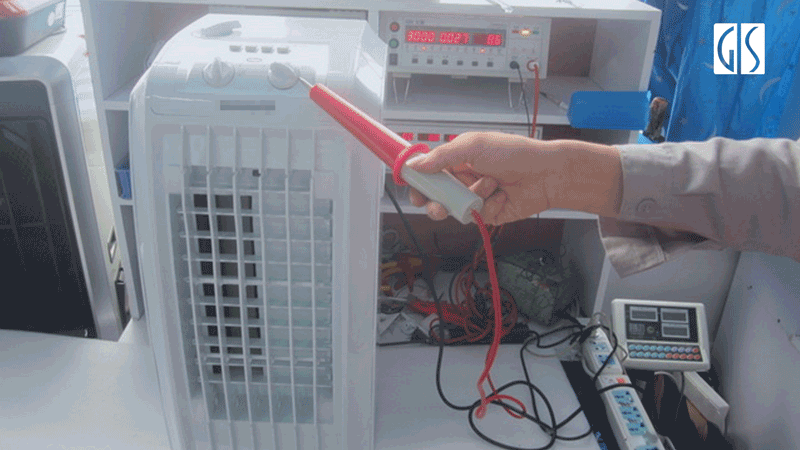
3.2 High voltage test
Conduct the test for 1 second (5mA) at the voltage required between the tested parts (the voltage refer to the actual category product requirement or otherwise refer to below. )
The testing voltage required:
For the USA/Canada markets:
- 1200V;
For European markets:
- class I 1000Vac;
- class II 2500Vac;
No insulation breakdown
3.3 Power on check
The good condition samples should be operating at full load (preferable) at least 4 hours at rated voltage or time reference the user instruction if less than 4 hours. After testing the samples should pass the hi voltage check, function check, earth continuity check etc., and no defect found.
3.4 Earth continually test if applicable
For European markets:
- luminary product: at least 10A for 1 second applied for the test and the resistance should be not more than 0.5 ohm.
- other household products: 25A for 1 second applied for the test and the resistance should be not more than 0.1 ohm.
For USA/CANADA markets:
- 25A for 1 second applied for the test and the resistance should be not more than 0.1 ohm.
3.5 Power cord strain relief test
IEC standard:
Pull on the cord for 25 times
If the product has a net weight <= 1kg, use a force of 30N. If the product has a net weight 1kg > , <= 4kg, use a force of 60N.
If the product has a net weight > 4 kg, use a force of 100N - The cord should not be displaced more than 2mm.
UL standard:
Pull on the cord for 35 lb 1min the cord should not be displaced.
3.6 Internal workmanship and critical component check
check internal construction completement and main components according with CDF (Constructional Data Form) or CCL (critical components list)
3.7 Stability test (for freely standing unit)
The unit is placed in any normal position of use on a plane inclined at an angle of 10°(15°for with heating element in Europe) to the horizontal, the supply cord resting on the inclined plane in the most unfavorable position. The appliance shall not overturn.
3.8 Gas leakage check
Use the gas detector to check the connection point between tube and compressor etc. gasline.no gas leakage found.
4. Functional Tests
4.1 Assembly/ installation check
Should be assembled/ installed smoothly according to the instruction manual or guideline, and no issue found.
4.2 Full function check
All captioned function is well conducted as intended. such as cooling /heating function, low voltage start, different mode function, louver function, remote control fu nction, compressor protection function check etc. all of function should be complied with claims.
4.3 Timer accuracy check (for with timing function item)
Timer should be set as per instruction manual and the actual time should be measured, the timer is set for 2 hours.
if no client requirement, the tolerance requirement is: electronics type +/- 1minutes, mechanical type +/-10%
4.4 Low voltage start check (for with motor item)
Apply 90% of rated voltage to the unit and turn on the unit. the unit should be started.
4.5 Power consumption check or input power/ current check
The power consumption /input power / current must comply with product spec and safety standard
4.6 Rotation speed check (for fan)
Apply rated voltage to the unit and check the rotation speed of the fan. it should be within requirement.
4.7 Noise check
Apply rated voltage to the unit and operating at highest setting, then measure the noise with the tester 1 m away from the unit. the noise level should be within requirement.
5. 0ther Test
5.1 Transportation drop test
No critical & Major issue found on package & product after (10 times) drop test according to the standard of ISTA 1A.
5.2 Dimensional Measurement
Product Size, power cord length, and Weight Measurement. According to product spec or approved sample. Apply +/-3% if no detail tolerance issued or requirement from client.
5.3 Bar code scan check
The bar code must be scannable and with the correct number.
5.4 Coating adhesive Tape Test
Use 3M 600 (or same performance tape) tape for an adhesion test on all painting, foil stamping, UV coating, printing. no more than 10% area peel off required.
5.4 Rubbing test for rating label and adhesive Test for printing, marking and logo
Rub the rating label for 15 seconds with water, then for 15 seconds with petroleum spirits.
GIS Inspection Air Conditioner Inspection Services in China and Asia
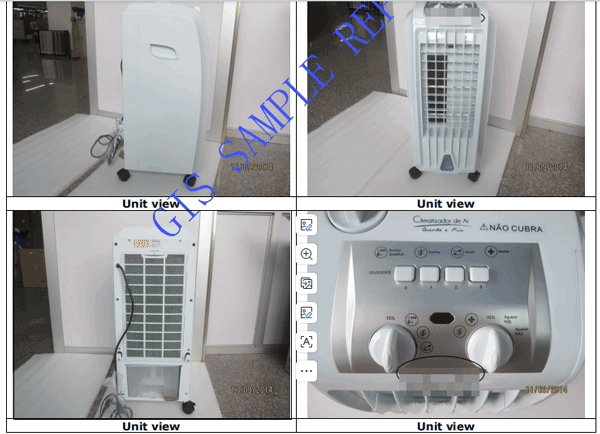 GIS pre-shipment inspection report for air conditiconer
General Inspection Services (GIS Inspection) provides quality control inspection services for split air conditioner and portable air conditioner at every stage: from supplier investigation, audit to the quality control, and final delivery of toilets during the process.
Factory Audit
GIS Inspection conducts independent Factory Inspections and Supplier Audits to help air conditioner buyers assess manufacturing competence, operational stability, and quality management practices before and during cooperation.
Pre-production Inspection
GIS Inspection provides pre-production inspection for AC to track assembly quality and catch early signs of issues such as poor component fit, incorrect wiring, material defects, missing parts, and non-compliance with product specifications. This helps reduce defect rates and improve overall production efficiency.
During Production Inspection
Once at least 20%~50% of the air conditioner order is completed, GIS Inspection performs a during-production inspection to evaluate:
- Component verification against the Bill of Materials (BOM)
- Refrigeration system assembly quality (compressor, condenser, evaporator, piping connection)
- Electrical wiring installation and safety compliance
- Fan motor operation and airflow performance
- Torque compliance for critical fasteners
- Welding and brazing quality of copper tubes and joints
Pre-Shipment Inspection
Before shipping, we perform a thorough pre-shipment inspection of your air conditioner to confirm:
- Accurate quantity, packaging, and labeling
- Appearance and workmanship
- Overall product quality and compliance with specifications
- Cooling and heating performance under rated conditions
- Electrical safety and insulation performance
- Refrigerant system integrity and leakage check
- Fan operation, airflow output, and noise level
- Control functions (remote control, modes, and temperature settings)
Container Loading Supervision
GIS Inspection verifies proper loading and positioning of air conditioner in containers to prevent shifting, scratching, or damage during transit. Packaging and strapping quality are also checked to ensure safe delivery to your destination.
With over 20 years of quality assurance experience across China and Asia, General Inspection Services is ready to help your business build strong and meaningful supplier relationships. Whether you need a China pre shipment inspection, or a supplier audit. We’re the best third-party quality inspection agency in China.
Book an air conditioner inspection service today!
FAQs
1. Why is air conditioner quality inspection important?
Air conditioner quality inspection helps identify defects before shipment, verify product performance, and ensure compliance with safety standards. It reduces the risk of product failures, customer complaints, recalls, and costly returns.
2. What is included in an air conditioner inspection report?
A typical air conditioner inspection report includes the general information of the
packaging inspection, appearance and workmanship checks, electrical safety tests, functional testing.
3. What safety standards apply to air conditioners?
The applicable standards depend on the destination market. Common standards include IEC 60335-1, IEC 60335-2-40, EN 60335-2-40, UL 60335-2-40, AS/NZS 60335.2.40, and GB 4706.32, along with energy efficiency and EMC regulations.
4. What are the types of an air conditioner quality control?
There are four types of an air conditioner quality control, including Pre-Production Inspection (PPI), During Production Inspection (DPI), Pre-Shipment Inspection (PSI), and Container Loading Supervision (CLS).
5. How much do Industrial Machinery Inspection services in China
Most inspection agencies offer competitive daily rates for inspectors, typically ranging from a ($200–$500/Manday, covering a full day’s work.
6. Why choose GIS Inspection for air conditioner quality control?
GIS Inspection provides professional third-party air conditioner inspection services based on international safety standards and customer specifications. Our experienced inspectors help importers and brands verify product quality, ensure compliance, and reduce supply chain risks before shipment.
7. How fast can I get the inspection report?
During the inspection, GIS inspectors provide real-time online feedback on any issues discovered. A detailed official inspection report, including the full checklist, is then delivered to the client within 24 working hours after the inspection is completed.
GIS Inspection
GIS Inspection (General Inspection Services), established in 2005 and headquartered in China, is an CNAS 17020, ISO 9001, and AQSIQ accredited third-party agency. We specialize in comprehensive quality control inspection and supply chain solutions for global buyers. By deploying a dedicated team of 100% full-time professional inspectors, GIS Inspection ensures peak integrity and technical consistency. Today, we are the trusted quality partner for over 12,000 global brands.
Email: lisaliu@gis-inspection.com