Sourcing table lamps and floor lamps from China? Quality inspection is essential to ensure product safety, compliance, and supply chain reliability.
A comprehensive and professional table lamp and floor lamp inspection checklist can help buyers identify quality issues before shipment, reduce risks, and ensure that lighting products meet customer and regulatory requirements.
In this article, we provide a detailed table lamp and floor lamp inspection checklist based on the requirements of EN 60598-1:2006. This comprehensive checklist covers key inspection points related to appearance, workmanship, dimensions, electrical safety, functionality, labeling, packaging, and performance, helping importers and sourcing professionals effectively control product quality and safeguard their supply chains.
1. Packing checking: gift box, carton, pallet
Material, sealing, straps, appearance, Printing and label: Bar code label, Logo, mark and any printing, logistic information label and other label
2. General Workmanship Check
Check the appearance of the table lamps and floor lamps: No dirt, rust, damage, crack, wrong/missing mark, scratch, rough surface, wobble base, loose part, white stress mark, shrink mark, mold mark, gap, etc.
3. Security Check
Hi-pot check
Conduct the test for 1 second (5mA) at the voltage required between the tested parts. The testing voltage required:
- For the USA/Canada markets: 1200Vac
- For European markets: 1500Vac;
no insulation breakdown.
Earth continuity check
- For European markets: luminary product: at least 10A for 1 second applied for the test and the resistance should be not more than 0.5 ohm.
- other household products: 25A for 1 second applied for the test and the resistance should be not more than 0.1 ohm.
- For USA/CANADA markets: 25A for 1 second applied for the test and the resistance should be not more than 0.1 ohm.
Polarity check
The live wire should be connected to center contact spring of lamp holder, and the neutral wire should be connected to shell of lamp holder.
Strain relief check
- For UL
All strain reliefs provided on a portable luminaire shall be tested as below. A 35pounds (16kg) weigh is suspended from the cord for 1 minute; The pull force is applied in a possible worst direction. For through cord switch or dimmer, the suspended force will be 20 pounds (9.1kg)
- For EU
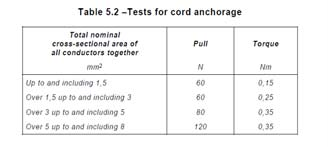
The cable or cord is then subjected 25 times to a pull of the value shown in Table 5.2. The pulls are applied without jerks, each time for 1 s.
The measurement of the longitudinal displacement of the cable or cord is made during this test. A mark is made on the cable or cord at a distance of approximately 20 mm from the cord anchorage while it is subjected to the first pull and during the 25th pull the mark shall not have been displaced by more than 2 mm.
Internal check
Check internal construction and components. the wire ways should be free from sharp edge or heating or moving to cause insulation damaged, internal connection should be security fixing and the component should be complied with requirement according with CDF or (critical component list) CCL.
Endurance check
Connect the lightings with rated voltage and power on with max rated lamp bulbs (if wattage of provided bulbs are same as the max rated power of lighting, then used the provided bulbs) for 4 hours (if Halogen or Xenon lighting, the duration should be 6 hours).
Stability check
Appliances (other than fixed appliances and hand-held appliances) is placed in any normal position of use on a plane inclined at an angle of 6°for Europe /8°for USA (for the special type such as toy like or outdoor portable lamp, 14° applied) to the horizontal, the supply cord resting on the inclined plane in the most unfavorable position. The appliance shall not overturn.
Tungsten-Halogen Torchiere abnormal Operation Test
The risk of fire indicator is to be a double-layered, bleached cheesecloth, and the cheesecloth pad should be large enough to cover the contour of guard/shade. Energized the torchiere for 15 minutes without cheesecloth covered, then place the cheesecloth pad on top of the unit so that it is centered along the axis of the torchiere as close the bulb as possible. Power on the torchiere for at least 6 hours.
Rain test (for wet location lightings)
Remove all the detachable parts then reinstalled, mounting the light as its mounting method.
Set water pressure to at least 34.5KPa (5PSI); Hold the spray head at about 55” (1400mm) distance from the light; Keep the spray head about 45degrees above of the horizon of the light; Simulate the actual use condition, spray water on the light in all directions (at least 4 directions) as it in an actual rain
Power on the light for at least 2 hours, then immediately spray water for 0.5hours as above mentioned method.
Immediately after rain test, Hi-pot check and visual check should be conducted.
Assembly check
Assembly the unit with provided components following the instruction manual.
Power cord strain relief test
For the product of Light Chain :
- for Europe: the pulling force(N) /nominal cross-sectional area of all conductors together(mm²): 60N/up to 3mm², 80(N)/more than 3mm² and no more than 5mm²; 120(N) for others;
- for USA: for 18AWG or larger, 30lbs; for smaller than 18AWG, 20lbs.
no detached, exposure of live parts or broken and lead displaced no more than 1.6mm
For other product of lighting:
- or EN 60589-1(luminaries product): S (mm²)=the total nominal cross sectional area of all the conductors together of the cord. If the S <= 3, use a force of 60N; If 3 < the S <= 5 ,use a force of 80N;If 5 < the S <= 8 , use a force of 120N.
- UL standard: Pull on the cord for 35 lb 1min the cord should not be displaced .
Tempered glass check
Power on the sample for 2hours and spray the cool water onto the lens, it should not break. Broken the glass lens, the particle pieces should not be sharp edge /point.
4. Functional Check
Basic function
- For lights without bulb pre-installed
- Live / neutral wire continuity check
- Check continuity between live wire and live connector of lamp sockets
- Check continuity between neutral wire and neutral connector of lamp socket
- Check to see if there is short circuit between live wire and neutral wire
- For light bulbs function check. (Unit provided with bulbs)
- Apply rate voltage to the light, turn on the light
- Bulb should be lighted, if other functions are equipped, they should work as intended
- Swivel joints function check
- All swivel joints with lead wires passing through should swivel smoothly, limited to 360 degrees and no risk of damage to lead wires.
- Switch function check
- Every switch should operate at each setting as intended, repeat checking for at least 3 cycles.
- Single pole switch should be installed on live wire. (For EU market)
Input power consumption
Turn on the bulb with rated voltage, record the power consumption.
Power on check
The good condition samples should be operating at full load (preferable) at least 4 hours at rated voltage or time reference the user instruction if less than 4 hours. after testing the samples should pass the hi voltage check, function check, earth continuity check etc., and no coating melt, smoke, burned mark, marking illegible etc. defect found.
5. Special Check
Drop test for remote controller
Freely drop the unit through a height of 1000mm onto a smooth concrete floor with 3mmT vinyle tile 3 times by different position, check the product unit after each drop. Any malfunction /construction broken or other major defect be found.
Learn details about drop test: https://www.gis-inspection.com/post/carton-drop-test-ista-standards
Rub and tape check
Rub the rating label for 15 seconds with water, then for 15 seconds with petroleum spirits.
6. Data Measurement
Measure the dimensions of the lighting products according to product spec or approved sample. Apply +/-3% if no detail tolerance issued or requirement from client.
Conclusion: GIS Quality Inspection Services for Table Lamps and Floor Lamps
General Inspection Service-GIS Inspection is a leading third-party quality control inspection company in China, providing on-site product inspection, supplier audit and lab testing support.
With 20 years of industry-wide experience, GIS Inspection helps lighting businesses reduce supply chain risks, ensure product quality consistency, and meet buyer expectations throughout the table lamps and floor lamps manufacturing process in China.
By combining advanced technology with decades of on-the-ground experience in lighting industry, GIS Inspection delivers comprehensive QC solutions in 60+ major cities throughout China and Southeast Asia.
GIS Inspection
GIS Inspection (General Inspection Services), established in 2005 and headquartered in China, is an CNAS 17020, ISO 9001, and AQSIQ accredited third-party agency. We specialize in comprehensive quality control inspection and supply chain solutions for global buyers. By deploying a dedicated team of 100% full-time professional inspectors, GIS Inspection ensures peak integrity and technical consistency. Today, we are the trusted quality partner for over 12,000 global brands.
Email: lisaliu@gis-inspection.com