

Importers from China should consider factory inspection as an essential step towards obtaining the right quality, cost, and delivery times. You deserve the best possible manufacturing partner, and audits will help assure that.
GIS Inspection provides professional factory evaluation and factory inspection services to help buyers gain a comprehensive understanding of a supplier's technical and quality capabilities, management practices, and compliance status.
Content
What is Factory Inspection?
Factory inspection is typically commissioned by buyers or importers and conducted by an independent third-party inspection company. The factory is assessed on-site according to specified standards and the buyer's requirements to determine its level of compliance.
A factory inspection is a comprehensive assessment of a supplier's or manufacturer's overall operations. Its purpose is to verify whether the factory's production capabilities, quality management systems, social responsibility practices, and other relevant areas meet the buyer's expectations and applicable industry standards.
Why Factory Inspection is Import?
A factory inspection is an essential part of supplier qualification and supply chain risk management. It enables buyers to verify a supplier's capabilities, identify potential risks, and make informed sourcing decisions.
A professional factory audit can help businesses:
- Verify the legitimacy of a new supplier: Confirm that the supplier is a genuine operating manufacturer and reduce the risk of fraud, misrepresentation, or unauthorized subcontracting.
- Ensure reliable product quality and delivery: Assess the factory's production capacity, manufacturing processes, quality control procedures, and ability to meet delivery requirements.
- Reduce financial, legal, and business interruption risks: Identify potential risks related to production, compliance, quality management, and operational continuity before they affect the buyer's business.
- Improve supply chain transparency and support long-term partnerships: Gain greater visibility into the supplier's operations, resources, production processes, and management systems.
- Protect brand reputation and meet social responsibility requirements: Evaluate workplace conditions, regulatory compliance, and other relevant social responsibility requirements to help protect the buyer's brand and reputation.
Through a systematic factory evaluation, buyers can identify qualified suppliers, allocate sourcing resources more effectively, and build a stronger foundation for a stable and sustainable supply chain.
When to Conduct a Factory Inspection?
Buyers typically conduct factory evaluations at key stages of the supplier relationship, which helps buyers identify potential risks early, improve supplier performance, and support more reliable long-term sourcing relationships.
1. Before Working with a New Supplier
A pre-qualification factory inspection helps buyers determine whether a prospective supplier has the required production capacity, quality management system, technical capabilities, and regulatory compliance to meet their requirements.
The audit can also verify information provided by the supplier, including:
- Factory ownership and operating status
- Factory size and production facilities
- Business licenses and relevant certifications
- Production capacity
- Manufacturing equipment and technology
- Quality control capabilities
- Workforce and technical personnel
- In-house and outsourced production activities
This helps buyers distinguish qualified manufacturers from trading companies, unsuitable suppliers, or suppliers whose capabilities have been overstated.
2. Before Major Orders or Specialized Projects
For high-value, high-volume, or strategically important orders, buyers need to determine whether the factory has sufficient resources and production capacity to fulfill the order on schedule.
For customized or technically demanding products, the evaluation should also verify whether the supplier has the necessary:
- Production equipment
- Technical expertise
- Engineering capabilities
- Manufacturing experience
- Process controls
- Testing and inspection facilities
This is particularly important when the product involves customized designs, special materials, complex manufacturing processes, or specific technical requirements.
3. When Quality Problems Occur Repeatedly
When a supplier repeatedly delivers products with quality issues, a factory inspection can help identify the root causes rather than simply detecting defects in finished products.
The assessment may focus on:
- Quality management procedures
- Incoming material inspection
- Production process controls
- In-process inspections
- Final inspection procedures
- Non-conforming product control
- Corrective and preventive actions (CAPA)
- Worker training and process discipline
- Production and quality records
If customer complaints or product returns increase, an on-site assessment can help determine whether deficiencies in the supplier's management system, manufacturing processes, or quality controls are contributing to the problem.
4. Periodic Audits of Existing Suppliers
Even after a supplier has been approved, regular factory inspection help buyers monitor whether the supplier continues to meet contractual, quality, technical, and compliance requirements.
Periodic evaluations can identify changes such as:
- Reduced production capacity
- Changes in key personnel
- Deterioration of production facilities
- Changes in quality management practices
- Increased subcontracting
- Expired or invalid certifications
- Changes in manufacturing processes
- Recurring quality issues
- Compliance gaps
Factory Inspection Procedure
A professional factory inspection follows a structured on-site assessment process designed to evaluate a supplier's manufacturing capability, production management, quality control system, and overall ability to meet the buyer's requirements.
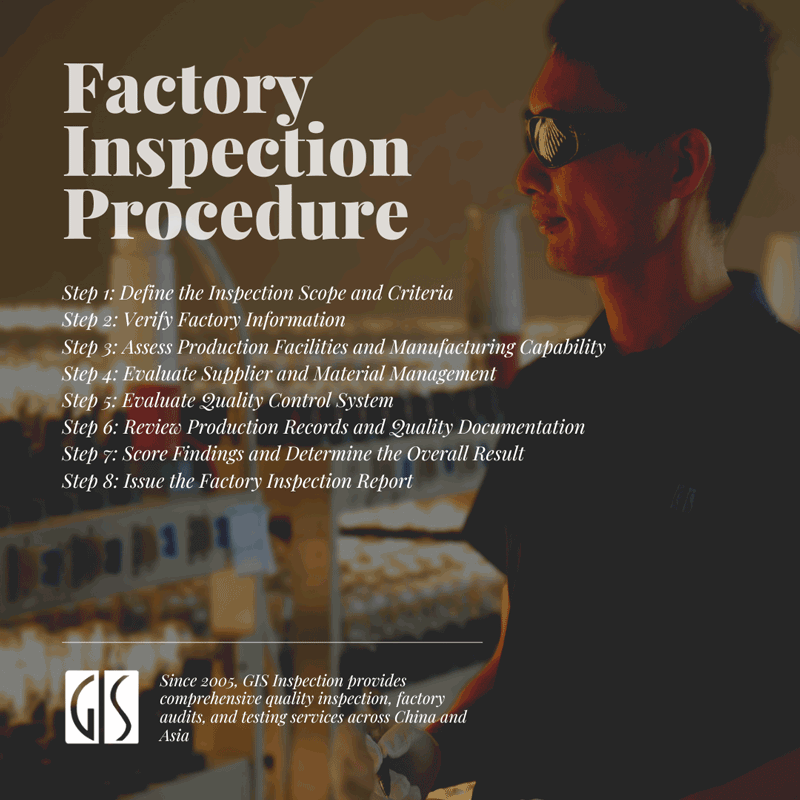
Step 1: Define the Inspection Scope and Criteria
Before the inspection, the buyer's requirements, product specifications, applicable standards, and supplier information are reviewed. The inspection scope and evaluation criteria are then established based on the purpose of the assessment, such as initial supplier qualification, periodic supplier evaluation, or follow-up assessment.
Step 2: Verify Factory Information
The inspector first verifies the factory's basic information and operating status, including:
- Factory name and address
- Contact information
- Factory ownership and operating status
- Number of employees and organizational structure
- Production history and export experience
- Main products and production areas
- Existing certifications and previous third-party audits
The factory's production capacity and main export markets may also be reviewed to determine whether its stated capabilities are consistent with its actual operations. GIS's sample plant evaluation report, for example, records manpower, monthly output, export markets, production areas, technical capabilities, and existing certifications.
Step 3: Assess Production Facilities and Manufacturing Capability
The inspector evaluates the factory's production facilities, workshops, warehouses, equipment, and manufacturing processes.
The assessment typically covers:
- Factory and workshop layout
- Production lines and equipment
- Production flow
- Infrastructure and utilities
- Working environment
- Production planning
- Manufacturing capacity
- Technical and product development capabilities
- Material handling and storage
The objective is to determine whether the factory has adequate resources and an effective production system to consistently meet customer requirements. GIS's evaluation criteria specifically cover factory layout, infrastructure, production workshops, production flow, working conditions, and production planning.
Step 4: Evaluate Supplier and Material Management
The inspector reviews how the factory selects and manages suppliers and controls incoming materials.
Key areas include:
- Supplier qualification and evaluation
- Raw material purchasing procedures
- Incoming material inspection
- Material identification and traceability
- Storage and handling
- Control of subcontracted products
This helps determine whether the factory can maintain consistent material quality throughout the production process.
Step 5: Evaluate Quality Control System
The quality management assessment is a key part of the factory inspection.
The inspector reviews:
- Incoming inspection
- In-process inspection
- Final inspection
- Inspection standards and procedures
- Inspection and testing equipment
- Equipment calibration and maintenance
- QC personnel and inspectors
- Training and competency
- Quality records and reports
- Sample management
- Non-conforming product control
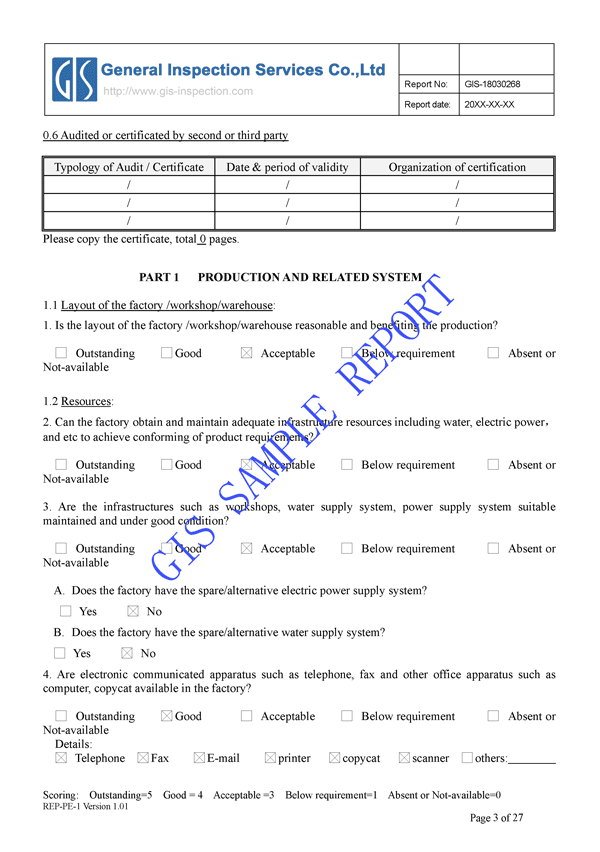
For example, the GIS sample report assesses whether incoming materials are inspected, whether adequate in-process inspection stations are established, and whether final inspection is conducted according to documented requirements.
Step 6: Review Production Records and Quality Documentation
Relevant production and quality records are reviewed to verify that the factory's documented procedures are actually implemented.
Depending on the scope, the review may include:
- Production records
- Inspection records
- Testing reports
- Calibration records
- Quality procedures
- Supplier evaluation records
- Training records
- Non-conformity records
- Corrective action records
The inspector checks whether records are properly maintained, traceable, complete, and supported by objective evidence. GIS's sample criteria specifically assess the identification, filing, retention, accuracy, and completeness of quality records.
Step 7: Score Findings and Determine the Overall Result
Each assessment item is evaluated against the defined inspection criteria. GIS's sample report uses a scoring system of Outstanding, Good, Acceptable, Below Requirement, and Absent or Not Available.
The scores are consolidated to determine the factory's overall performance and identify areas requiring improvement.
Step 8: Issue the Factory Inspection Report
After completing the on-site assessment, the inspector compiles the findings into a formal factory inspection report.
The report normally includes the factory profile, assessment results, scores, findings, supporting evidence, photographs, conclusions, and recommendations. Where applicable, follow-up actions or corrective action requirements are also identified.
Need to Verify Your Supplier Before Placing an Order?
GIS Inspection provides professional factory inspection and supplier assessment services in China and other major manufacturing markets.
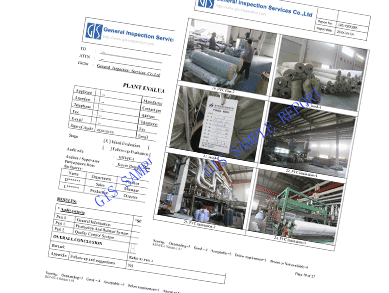
What Is Included in a Factory Inspection Report?
A professional factory inspection report provides buyers with objective information about a supplier's facilities, production capability, quality management system, and overall suitability.
The exact contents vary according to the inspection scope and buyer requirements, but a comprehensive report typically includes the following sections.
1. Factory and Inspection Information
The report begins with basic information that identifies the supplier and the inspection:
- Report date
- Factory address
- Contact information
- Inspection date
- Auditor/inspector
- Factory representatives
- Applicable audit or inspection criteria
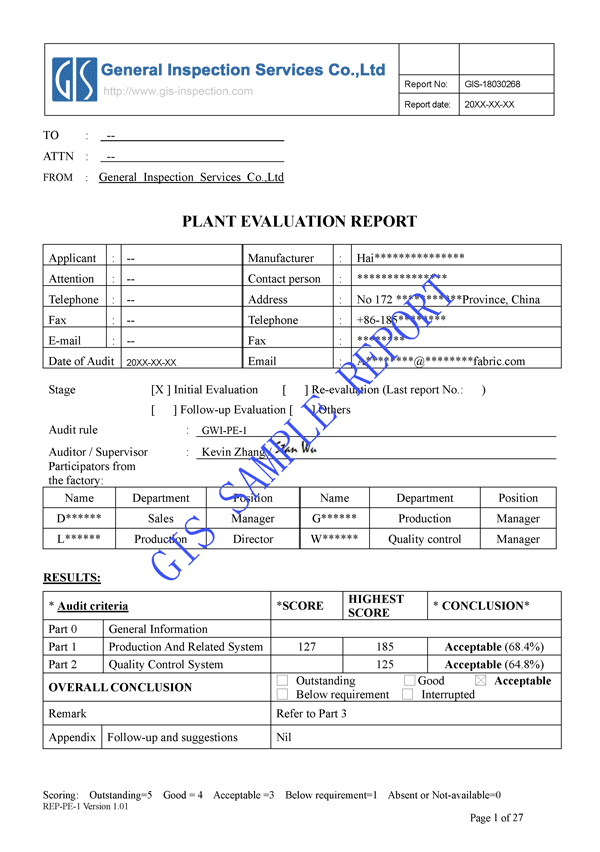
GIS's sample report records the report number, date, manufacturer, address, audit date, inspection stage, audit rule, auditor, and factory participants.
2. Executive Summary and Overall Assessment
The report provides an overview of the assessment results and the factory's overall performance.
This section may include:
- Overall conclusion
- Score achieved
- Maximum possible score
- Performance rating
- Key strengths
- Major weaknesses
- Critical observations
- Follow-up recommendations
In the GIS sample report, the overall conclusion is based on the scores for Production and Related System and Quality Control System, with the final result categorized according to the defined rating system.
3. Factory Profile
The factory profile provides a snapshot of the supplier's size, resources, and operating capabilities.
Typical information includes:
- Total workforce
- Management and technical personnel
- QC personnel
- Production workers
- Working shifts
- Production history
- Monthly production capacity
- Export experience
- Main export markets
- Production locations
- Main manufacturing processes
- Product development capabilities
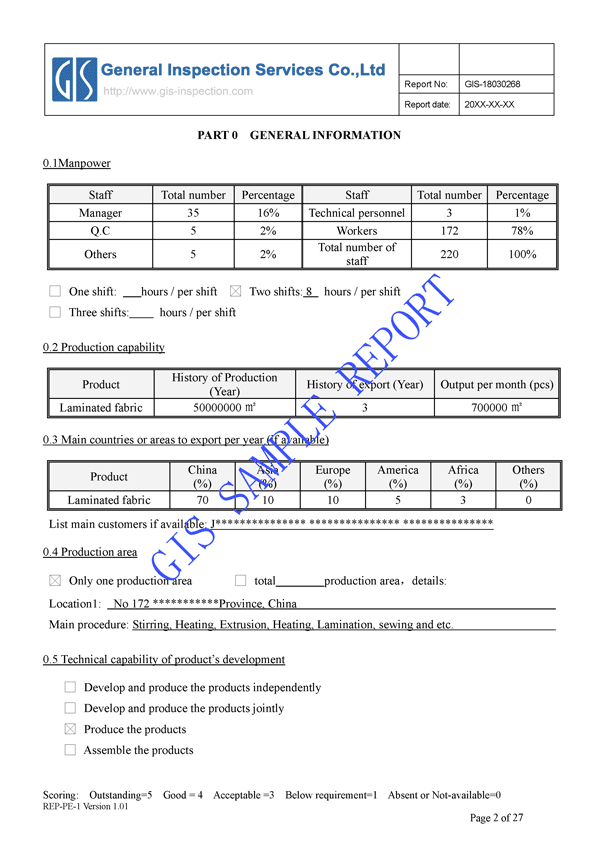
For example, the GIS textile plant evaluation report records workforce composition, production output, export markets, production areas, manufacturing processes, and technical capabilities.
4. Production and Manufacturing Assessment
This section evaluates whether the factory has the facilities, resources, and production controls necessary to manufacture the products consistently.
It may cover:
- Factory and workshop layout
- Production facilities
- Machinery and equipment
- Production lines
- Manufacturing processes
- Production flow
- Production planning
- Production capacity
- Infrastructure
- Working environment
- Material storage and handling
- Warehouse management
The objective is to determine whether the supplier has sufficient operational capability to meet the buyer's production and delivery requirements.
5. Quality Control System
A factory inspection report should provide a detailed assessment of the supplier's quality management and inspection controls.
Typical areas include:
Incoming Quality Control
- Raw material inspection
- Supplier material verification
- Receiving inspection procedures
In-Process Quality Control
- Inspection stations
- Inspection frequency
- Process control
- Inspector competency
- Work instructions
Final Quality Control
- Final inspection standards
- Inspection methods
- Batch inspection
- Product release procedures
Inspection and Testing Equipment
- Availability of testing equipment
- Calibration
- Equipment maintenance
- Measurement accuracy
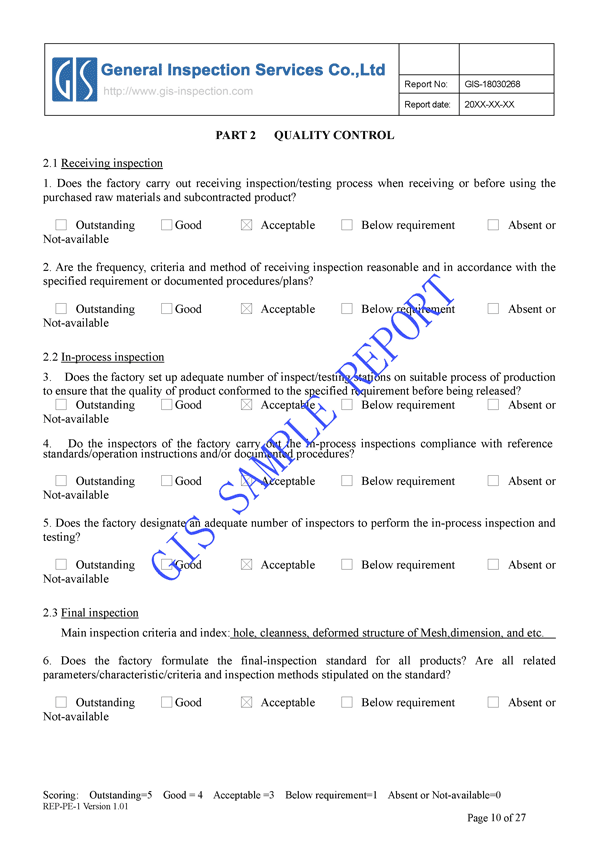
GIS's sample report specifically evaluates incoming inspection, in-process inspection, final inspection, testing equipment, calibration, and QC personnel competency.
6. Quality Records and Traceability
The report assesses whether the factory maintains reliable quality documentation and traceability throughout production.
This may include:
- Incoming inspection records
- In-process inspection records
- Final inspection reports
- Test reports
- Production records
- Calibration records
- Sample approval records
- Non-conformity records
- Corrective action records
The inspector also evaluates whether records are properly identified, maintained, traceable, complete, and supported by appropriate signatures or approvals.
7. Warehouse and Material Control
The report may document how raw materials, work-in-progress, and finished goods are stored and controlled.
Typical checks include:
- Warehouse capacity
- Cleanliness and organization
- Material identification
- Batch/lot identification
- Protection against damage or deterioration
- Storage conditions
- Stock receiving and dispatch procedures
- Finished goods control
These controls are important for preventing material mix-ups, damage, contamination, and inventory discrepancies. GIS's sample report includes specific checks for warehouse capacity, storage conditions, product identification, and stock control.
8. Existing Certifications and Third-Party Audits
Where applicable, the report records the factory's existing certifications and previous audits, including:
- Certification or audit type
- Certification body
- Issue date
- Validity period
- Certificate details
Copies of relevant certificates may also be included as supporting evidence.
9. Findings and Non-Conformities
The report identifies areas where the factory does not fully meet the applicable requirements.
Findings may relate to:
- Production capability
- Quality control
- Documentation
- Equipment
- Material management
- Warehouse management
- Process control
- Traceability
- Compliance
Objective evidence, observations, and photographs should be provided where appropriate.
10. Corrective Actions and Recommendations
Where deficiencies are identified, the report can provide recommendations or corrective action requirements.
These may include:
- Corrective action required
- Responsible department
- Recommended completion timeline
- Supporting evidence required
- Follow-up inspection requirements
This enables buyers to track whether identified weaknesses have been effectively addressed.
11. Photographic Evidence
Photos provide objective visual evidence of the factory's actual condition and help buyers verify the findings reported by the inspector.
Typical photographs may show:
- Factory exterior
- Production workshops
- Production lines
- Machinery and equipment
- Warehouses
- Raw materials
- QC laboratories
- Inspection equipment
- Quality records
- Identified non-conformities
12. Final Conclusion
The final section summarizes the factory's overall suitability based on the inspection findings and scoring results.
Depending on the buyer's criteria, the conclusion may indicate whether the supplier is:
- Approved
- Approved with Conditions
- Requires Corrective Action
- Requires Follow-up Evaluation
- Not Recommended
A well-structured factory inspection report allows buyers to move beyond a supplier's self-declared capabilities and make sourcing decisions based on objective, on-site evidence.
Real Example: A Factory Inspection for a Textile Manufacturer
A South American textile buyer commissioned GIS Inspection to evaluate a Chinese textile manufacturer before establishing a long-term sourcing relationship. The objective was to verify the factory’s production capacity, manufacturing processes, quality control system, and overall readiness to meet international customer requirements.
During the on-site factory evaluation, GIS reviewed the manufacturer’s workforce, production facilities, equipment, raw material management, production planning, subcontracting, warehouse operations, and quality control procedures.
The factory had 220 employees, including 172 production workers and 5 QC personnel, with a reported monthly production capacity of approximately 700,000 square meters of laminated fabric. Its main processes included PVC film extrusion, lamination, and sewing. GIS also reviewed key production equipment, equipment maintenance, operating instructions, operator training, and process control.
Quality management was another major focus. GIS assessed incoming material inspection, in-process inspection, final inspection, inspection equipment, QC personnel, sample management, quality records, and nonconforming product control. Final inspection criteria included factors such as holes, cleanliness, mesh deformation, and dimensions.
The evaluation resulted in a score of 68.4% for the Production and Related System and 64.8% for the Quality Control System, with the overall conclusion rated Acceptable.
GIS also identified several points requiring further attention, including a discrepancy between the factory name and the booking information, the lack of documentary financial evidence, and limited disclosure of market and customer information.
For the South American buyer, the inspection provided an independent assessment of the supplier’s capabilities and highlighted potential risks before cooperation. This enabled the buyer to make a more informed sourcing decision and establish appropriate quality control measures for future orders.
The Difference between Factory Inspection and Product Inspection
Factory inspection and product inspection serve different purposes in quality control. Factory inspection evaluates the supplier and its manufacturing capabilities, while product inspection focuses on the actual products to verify whether they meet the buyer’s specifications and quality requirements.
|
Factory Inspection |
Product Inspection |
|
|
Main purpose |
Assess whether a supplier is reliable and capable of producing consistently compliant products. |
Verify whether the manufactured products meet the required quality, specifications, and safety requirements. |
|
Main focus |
Factory facilities, production capacity, machinery, workforce, production processes, quality control systems, and compliance. |
Product appearance, workmanship, dimensions, quantity, function, performance, packaging, labeling, and other specified requirements. |
|
When it is conducted |
Usually before selecting a new supplier or starting mass production, and may also be performed periodically for existing suppliers. |
Can be conducted before production, during production, before shipment, or during loading, depending on the inspection type. |
|
Typical result |
A factory audit/assessment report identifying the supplier’s strengths, risks, non-conformities, and overall capability. |
A product inspection report showing whether the inspected goods conform to the specified requirements. |
In simple terms: Factory inspection answers “Can this supplier reliably produce what we need?” Product inspection answers “Does the product they produced meet our requirements?” For higher supply-chain assurance, buyers may use both services as complementary quality control measures.
Factory Inspection FAQs
Q1. What is a factory inspection?
A factory inspection, also known as a factory audit or assessment, is an on-site evaluation of a supplier’s operations, production capabilities, quality management systems, legal compliance, and overall reliability. It helps buyers verify whether a supplier is capable of consistently meeting their requirements.
Q2. What is checked during a factory inspection?
A factory inspection typically covers general company information, production capabilities, factory facilities, production processes, equipment, quality control systems, warehousing, and product traceability. GIS also evaluates receiving, in-process, and final inspection procedures.
Q3. How long does a factory inspection take?
The inspection duration depends on the factory size, inspection scope, production complexity, and required assessment criteria. GIS generally considers one man-day as one inspector working for one day, with a meaningful on-site inspection typically taking around 6–8 hours.
Q4. What documents are checked during a factory inspection?
Auditors may review documents such as the business license, import/export license, production licenses, certifications, quality records, inspection reports, production procedures, and other relevant compliance documents. The exact documents depend on the factory and audit requirements.
Q5. What happens if a factory fails the inspection?
A failed or poorly rated factory does not necessarily mean cooperation must stop. The audit report identifies non-conformities, key findings, and recommendations, allowing buyers to request corrective actions or reconsider the supplier before placing an order.
Q6. How much does a factory inspection cost?
GIS charges USD 200 per man-day for factory audits in major manufacturing areas of China, while additional travel expenses may apply in other locations.
Q7. Can I receive the factory inspection report on the same day?
GIS provides detailed inspection reports within 24 hours after the inspection, including findings, photos, and relevant assessment results. Same-day delivery may therefore depend on the inspection completion time and report review process.
GIS Inspection
GIS Inspection (General Inspection Services), established in 2005 and headquartered in China, is an CNAS 17020, ISO 9001, and AQSIQ accredited third-party agency. We specialize in comprehensive quality control inspection and supply chain solutions for global buyers. By deploying a dedicated team of 100% full-time professional inspectors, GIS Inspection ensures peak integrity and technical consistency. Today, we are the trusted quality partner for over 12,000 global brands.
Email: lisaliu@gis-inspection.com