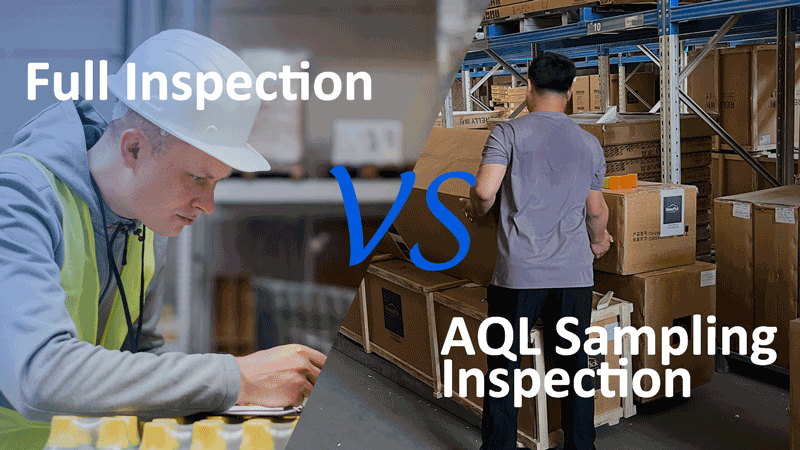
Full inspection (100% inspection) and AQL sampling inspection are two prominent methods for verifying product conformity before goods leave the factory. Both play a critical role in preventing costly mistakes, ensuring compliance with buyer specifications, and maintaining brand reputation.
In this blog, we’ll explore the fundamentals of 100% inspection and sampling inspection, compare their effectiveness and help you determine the right quality control method for your organization.
Content
Full Inspection (100% Inspection)
Full inspection is checking each unit in a production lot to confirm compliance with defined quality standards.
Benefits of Full Inspection
The key benefits of full inspection include:
- Improved product quality: Every item is scrutinized to ensure it meets all specifications.
- Higher customer satisfaction: Products are more reliable, leading to fewer complaints or returns.
- Reduced costs: Early detection of defects prevents rework, recalls, and warranty claims.
- Risk mitigation: Especially in safety-critical industries, defects can cause regulatory issues or serious safety incidents—full inspection helps prevent this.
How Full Inspection Works
In a 100% inspection process, each item undergoes a detailed evaluation against predetermined quality standards. This can include visual inspections, functional testing and measuring specifications. Each product must pass these inspections to be considered fit for distribution.
When Should You Conduct a Full Inspection?
From GIS 20 years’ experience, we would point to seven reasons some importers want a 100% check:
- There is a strong suspicion that the following batch has quality issues and the supplier hasn’t done a good QC job — this is a classic after a first inspection failed and receiving a complaint from the customer for previous batch but there was no reaction.
- For small batches of expensive products (think jewels), a customer might want a 100% inspection.
- There is a risk that good products get replaced by bad ones after inspectors are gone — sorting good pieces into cartons that are immediately sealed makes this swapping game harder to play.
- When the goods need to be re-processed in another facility before shipment. There are many cases where products coming from different factories have to be kitted and/or packed together.
- When the sample products don’t meet your specifications, even with poor quality needing piece by piece check.
- An issue with a production process might make some products unsellable. When you require a strong control of the production process and the goods must be shipped in time. For example, it is critical for you to ensure the ample supply when you will do a special promotion and the sales starts next week.
- In some cases, the customer badly needs some more products, and they have to send an inspection company to check the products that were previously seen as unacceptable. If they give revised (lower) standards, many products might be “saved” this way.
Example:
Machinery and Equipment Inspection: A complete beer brewing production line or a shipment of several overhead cranes, where every machine is high-value, customized, and critical to production. In these cases, 100% inspection is recommended to verify functionality, dimensions, workmanship, documentation, and compliance before shipment.
Advantages and Disadvantages of 100% Inspection
Advantages:
- Higher Assurance: Every item is checked for defects.
- Better for Critical Products: Reduces the risk of dangerous or expensive failures.
Disadvantages:
- Time-consuming: Checking every item takes longer than sampling.
- Costly: Requires more manpower, time, and inspection equipment.
- Human error: Fatigue or oversight can lead to missed defects, especially in manual inspections.
- Scalability issues: May not be feasible for large-scale or high-volume production.
AQL Sampling Inspection
An AQL Sampling Inspection is a surprise check-up on a batch of products before they're shipped. Instead of checking every single item, inspectors choose a random sample. An independent third-party inspector will use a pre-defined randomization method (ISO 2859-1 / ANSI/ASQC Z1.4) to choose the samples from the production line or finished goods inventory.
AQL is not a guarantee of quality — it is a statement of acceptable risk.
Example:
When you specify AQL 2.5 at General Inspection Level II for a batch of 5,000 units, you are drawing a sample of 200 units and accepting the batch if no more than 10 defective units are found. If 10 defects appear in 200 units, the statistical inference is that roughly 5% of the full batch may be defective — but the framework accepts this outcome as within tolerance for your product category.
What is ISO 2859-1 / ANSI/ASQC Z1.4?
In more than 95% of cases, quality inspectors who are performing random sampling AQL inspections are following a standard that guides them: ISO 2859-1: Sampling procedures for inspection by attributes — Part 1: Sampling schemes indexed by acceptance quality limit (AQL) for lot-by-lot inspection.
The standard helps the inspector know:
- The number of products that should be taken out as a sample and inspected, based on the inspection level you mandated.
- The AQL (acceptance quality limits) that dictate what percentage of products are permitted to ‘fail’ the inspection before the whole batch is classified as a failure.
The inspector can simply use the ISO 2859-1 master tables, commonly called AQL tables, to calculate the sample size and the AQL limits based on the inspection level chosen. That level should be appropriate to the situation and products (for instance, a higher or special inspection level will be applicable for cases where you have more or fewer suspicions or tolerance of quality issues – more on this later…).
When Should You Conduct an AQL Sampling Inspection?
By default, most buyers try to keep the volume of work low, by doing a random inspection.
And, in the vast majority of cases, for consumer goods, they follow the ISO 2859-1 (or ANSI/ASQ Z1.4) standard, set an inspection level, and set AQL limits.
The classic scenario goes as follows. A quality inspector (working for the buyer, or working for a QA agency appointed by the buyer):
- Goes to the supplier’s factory
- Counts the presented quantity, picks boxes & products at random
- Checks the products and their packing for visual defects
- Confirms specifications are met
- Prepares a report that includes a pass/fail result
Example:
For a fashion retailer sourcing 10,000 jeans from a supplier in China or Vietnam, it is impractical to inspect each shirt individually. AQL sampling allows them to ensure reasonable quality standards without delaying shipments or inflating inspection costs.
Advantages and Disadvantages of AQL
Advantages:
- Cost-efficient: Fewer resources are needed compared to inspecting everything.
- Time-saving: Quick turnaround for large orders.
- Statistical Confidence: Balances speed with a reliable assessment of quality.
Disadvantages:
- Risk of Escaped Defects: Defective units not in the sample may go unnoticed.
- Sample Bias: If the random sample is not truly random, results can be misleading.
Comparison of Full Inspection and AQL Sampling Inspection
|
Criteria |
AQL |
100% Inspection |
|
Cost |
Generally lower |
Higher due to time and labor |
|
Time Efficiency |
Faster inspection process |
Slower, as every item is checked |
|
Defect Detection |
May miss low-frequency defects |
Catches every defect |
|
Best For |
High-volume production |
Safety-critical applications |
|
Customer Satisfaction |
May vary when accepting defects |
Higher due to total assurance |
When to Use Full Inspection vs AQL Sampling Inspection
The following table provides practical recommendations from GIS Inspection to help buyers choose the most effective inspection approach based on product risk, production characteristics, and supplier reliability.
|
Product Risk Profile |
GIS Inspection Recommended Approach |
GIS Inspection Services |
Typical Products |
|
Low-value consumer productsHigh production volume, low consequence of defects |
AQL Sampling Inspection GII, AQL 2.5–4.0 |
Apparel, footwear, bags, household goods, gifts, pet products, promotional products |
|
|
Medium-risk functional products Products requiring performance verification |
AQL Sampling Inspection GII, AQL 1.5–4.0 |
During Production Inspection (DPI) + PSI |
Consumer electronics, power tools, lighting products, home appliances |
|
High-value industrial equipment Complex products with high replacement costs |
Risk-based inspection including 100% functional verification, dimensional measurement, key component verification and AQL appearance inspection |
PSI + Container Loading Supervision |
Industrial machinery, automation equipment, laboratory instruments, industrial sensors |
|
Safety-critical or regulated products Products subject to mandatory safety or compliance requirements |
100% inspection of critical safety items, functional verification, compliance checks, documentation review and on-site testing |
Product Inspection + Product Testing + Factory Audit |
Medical devices, electrical equipment, children's products, PPE, automotive components |
|
New suppliers or first production orders |
Start with Factory Audit + During Production Inspection + 100% inspection (or tightened AQL) for the first shipment(s), then optimize to normal AQL based on supplier performance |
Factory Audit + DPI + PSI |
All product categories from new or unverified suppliers |
|
Recurring orders from qualified suppliers |
Maintain consistent quality through Normal AQL Inspection, supported by periodic supplier audits and process monitoring |
PSI + Periodic Factory Audit |
Mature products with stable manufacturing processes |
|
High-volume export shipments Multiple cartons or containers |
Combine AQL Inspection with Container Loading Supervision to minimize shipping and loading risks |
Furniture, building materials, consumer goods, industrial products |
How to Choose a Professional Inspection Service Provider
If you lack internal resources, working with a third-party inspection provider like GIS Inspection can be a smart option. When selecting a provider, consider:
- Industry experience and familiarity with your product category
- Reputation for accuracy, professionalism, and compliance (GIS has 20 years of experience.)
- Certifications, such as ISO/IEC 17020
- Transparent reporting, communication, and competitive pricing
FAQs
Q1. What is the difference between full inspection and AQL sampling inspection?
Full inspection checks every single unit. Sampling inspection checks a representative sample of a batch and infers the batch's quality statistically. Sampling is cheaper and faster but accepts some statistical risk; Full inspection is thorough but costly.
Q2. When should I use sampling inspection?
For stable, capable processes that produce few defects, where checking every unit would be wasteful, and for destructive testing where you cannot test every unit. A properly-sized random sample confirms the batch quality with known confidence at a fraction of the cost.
Q3. When is 100% inspection necessary?
For critical characteristics where no defect can be tolerated, or for unstable processes producing defects too unpredictably for sampling to be trusted. Because manual inspectors miss defects even at 100%, effective 100% inspection should be automated.
Q4. Does 100% inspection guarantee zero defects?
No. Human inspectors miss a proportion of defects — research indicates 20–30% across inspection task types — due to fatigue, visual similarity of defects to conforming product, and attention variance across long inspection sessions.
Automated inspection systems achieve higher detection rates, but for most factory settings, 100% inspection is best understood as a significant risk reduction rather than an absolute guarantee. The combination of 100% functional testing (where a test either passes or fails objectively) and AQL visual inspection provides the strongest achievable quality gate for most high-tech equipment.
GIS Inspection
GIS Inspection (General Inspection Services), established in 2005 and headquartered in China, is an CNAS 17020, ISO 9001, and AQSIQ accredited third-party agency. We specialize in comprehensive quality control inspection and supply chain solutions for global buyers. By deploying a dedicated team of 100% full-time professional inspectors, GIS Inspection ensures peak integrity and technical consistency. Today, we are the trusted quality partner for over 12,000 global brands.
Email: lisaliu@gis-inspection.com