In global manufacturing, structured quality inspection is essential for reducing product risks and maintaining consistent quality. ISO 2859-1 provides a widely recognized framework for AQL sampling inspection, helping buyers assess large production lots without checking every unit.
Whether you are sourcing textiles, apparel, electronics, furniture, or consumer goods, understanding how AQL works under ISO 2859-1 standards is essential for making informed inspection decisions.
This guide explains AQL levels, sampling parameters, defect classifications, national equivalents, and ISO 2859-1 vs. ANSI/ASQ Z1.4.
What Is ISO 2859-1?
ISO 2859-1 (Sampling procedures for inspection by attributes — Part 1: Sampling schemes indexed by acceptance quality limit (AQL) for lot-by-lot inspection) is an internationally recognized standard for acceptance sampling in quality control, which outlines the procedures for sampling and inspecting batches of products.
The purpose of this standard is to guide companies in determining whether a batch of products should be accepted or rejected based on sampling inspection rather than 100% inspection. The goal is to reduce costs, minimize inspection time, and maintain an acceptable quality level (AQL).
ISO 2859-1:2026 Update: Key Changes and New Requirements
ISO published a revised edition, ISO 2859-1:2026, in January 2026, replacing the previous edition from 1999 along with its amendments.
The ISO 2859-1:2026 edition introduces skip-lot sampling procedures, updated guidance for applying sampling strategies, The core mechanics – AQL values, inspection levels, sample size tables, acceptance and rejection numbers – remain consistent with what you already know.
1. Skip-Lot Sampling Is Now Included
The most significant change is the introduction of a formal skip-lot sampling procedure.
Under the new procedure, not every lot in a continuing series needs to be physically inspected. When a supplier and product demonstrate consistently good quality and meet the specified qualification criteria, some lots can be randomly selected to skip inspection and be accepted without inspection.
The standard defines skip-lot inspection as a procedure in which some lots are accepted without inspection when the preceding inspection results meet specified criteria. The standard also provides rules for randomly selecting which lots will be inspected or skipped.
This gives buyers a way to reduce inspection effort while maintaining a structured statistical approach.
2. New Qualification Requirements for Skip-Lot Sampling
ISO 2859-1:2026 does not simply allow an inspection company to start skipping lots because a supplier has a good inspection history.
The new edition provides guidance on producer and product qualification for skip-lot sampling. In other words, the supplier and the products must satisfy defined conditions before this reduced inspection approach is appropriate.
This is important for practical quality control: skip-lot sampling should be treated as a controlled quality-management strategy, not simply as a way to reduce inspection costs.
3. New Guidance on When and How to Apply Skip-Lot Inspection
The 2026 edition adds guidance for evaluating whether skip-lot sampling is effective and how to select lots for inspection or skipping.
The standard specifically addresses methods for random selection of lots, helping prevent suppliers or inspectors from selectively choosing which production lots are inspected.
This strengthens the statistical basis of the procedure and helps maintain the credibility of acceptance sampling.
4. OC and ASN Curves Have Been Reorganized
Another technical change concerns Operating Characteristic (OC) curves and Average Sample Number (ASN) curves.
The 1999 edition provided OC curves for individual sampling plans. In ISO 2859-1:2026, these printed curves have been removed. Instead, Annex E provides methods for constructing the OC and ASN curves for individual sampling plans.
This makes the standard more flexible for analyzing specific sampling plans rather than relying solely on pre-published curves.
Comparative Summary: ISO 2859-1:1999 vs. ISO 2859-1:2026
|
Area |
ISO 2859-1:1999 |
ISO 2859-1:2026 |
|
AQL-based sampling |
✓ |
✓ |
|
Single sampling |
✓ |
✓ |
|
Double sampling |
✓ |
✓ |
|
Multiple sampling |
✓ |
✓ |
|
Normal/reduced/tightened inspection |
✓ |
✓ |
|
Skip-lot sampling |
— |
New |
|
Skip-lot qualification guidance |
— |
New |
|
Random selection of lots for skip-lot inspection |
— |
New |
|
Skip-lot effectiveness guidance |
— |
New |
|
Printed OC curves for individual plans |
✓ |
Removed |
|
OC/ASN curve construction methods |
Limited |
Annex E |
|
Relationship with ISO 2859-0 |
Recommended |
Recommended |
How to Select the Appropriate AQL for Product Inspection?
There is a fairly obvious principle in statistical quality control: the greater the order quantity, the higher the number of samples to check.
But should the number of samples ONLY depend on the order quantity? What if this factory had many quality problems recently, and you suspect there are many defects? In this case, you might want more products to be checked.
On the other hand, if an inspection requires tests that end up in product destruction, shouldn’t the sample size be drastically reduced? And if the quality issues are always present on all the products of a given batch (for reasons inherent to processes at work), why not check only a few samples?
It is usually the buyer’s responsibility to choose the inspection level–more samples to check means more chances to reject bad products when they are bad, but it may also mean more days (and dollars) spent on an inspection.
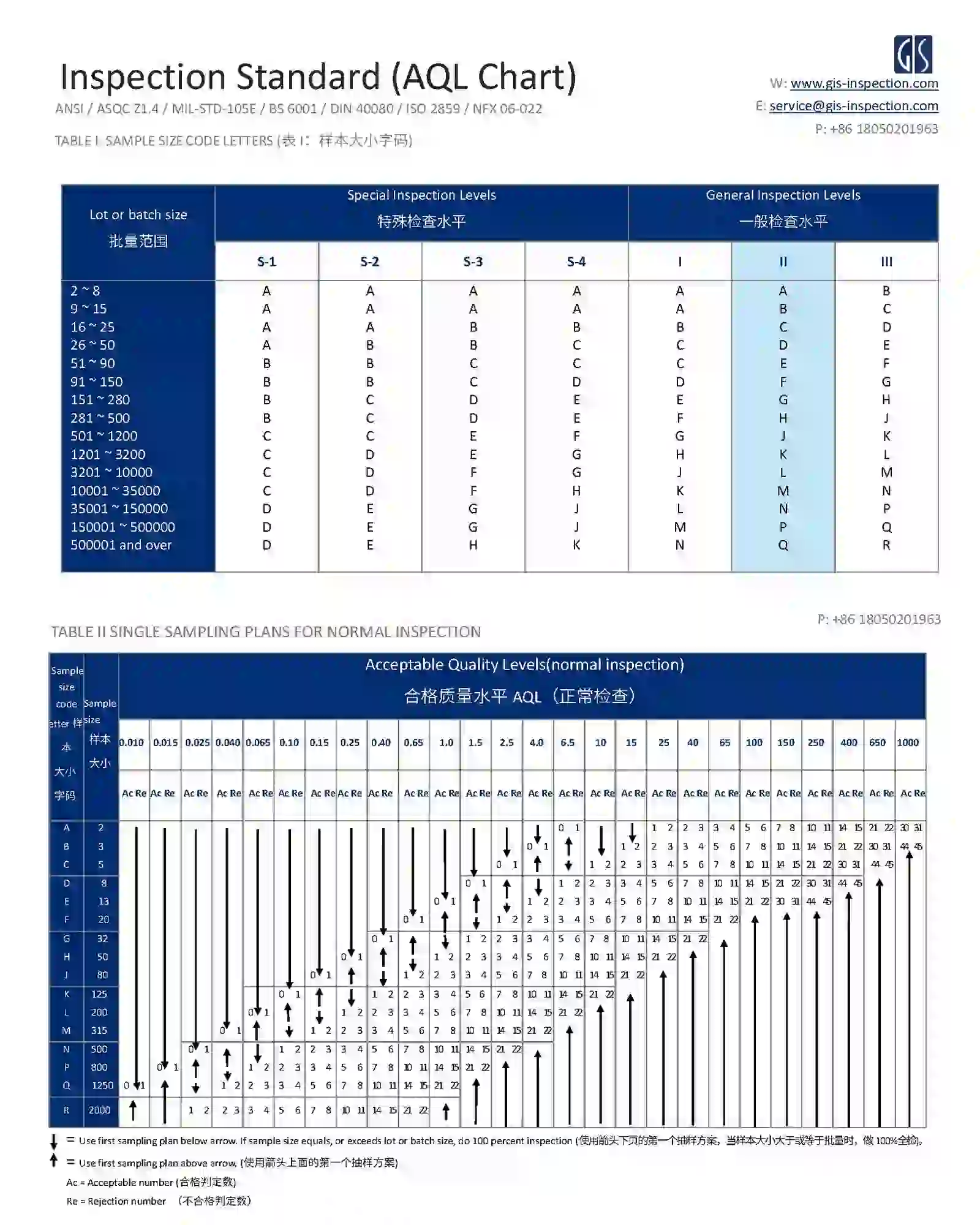
Which inspection level is normal?
Inspection level II (under “normal severity”) is appropriate for the visual check, in most inspections. But they all have a purpose and will be chosen based on the context and the content of the inspection.
What are the inspection levels and when are they used?
The AQL inspection levels that you choose are relevant in different scenarios and you, the importer, need to advise your quality inspector which to follow.
The 3 “general” inspection levels
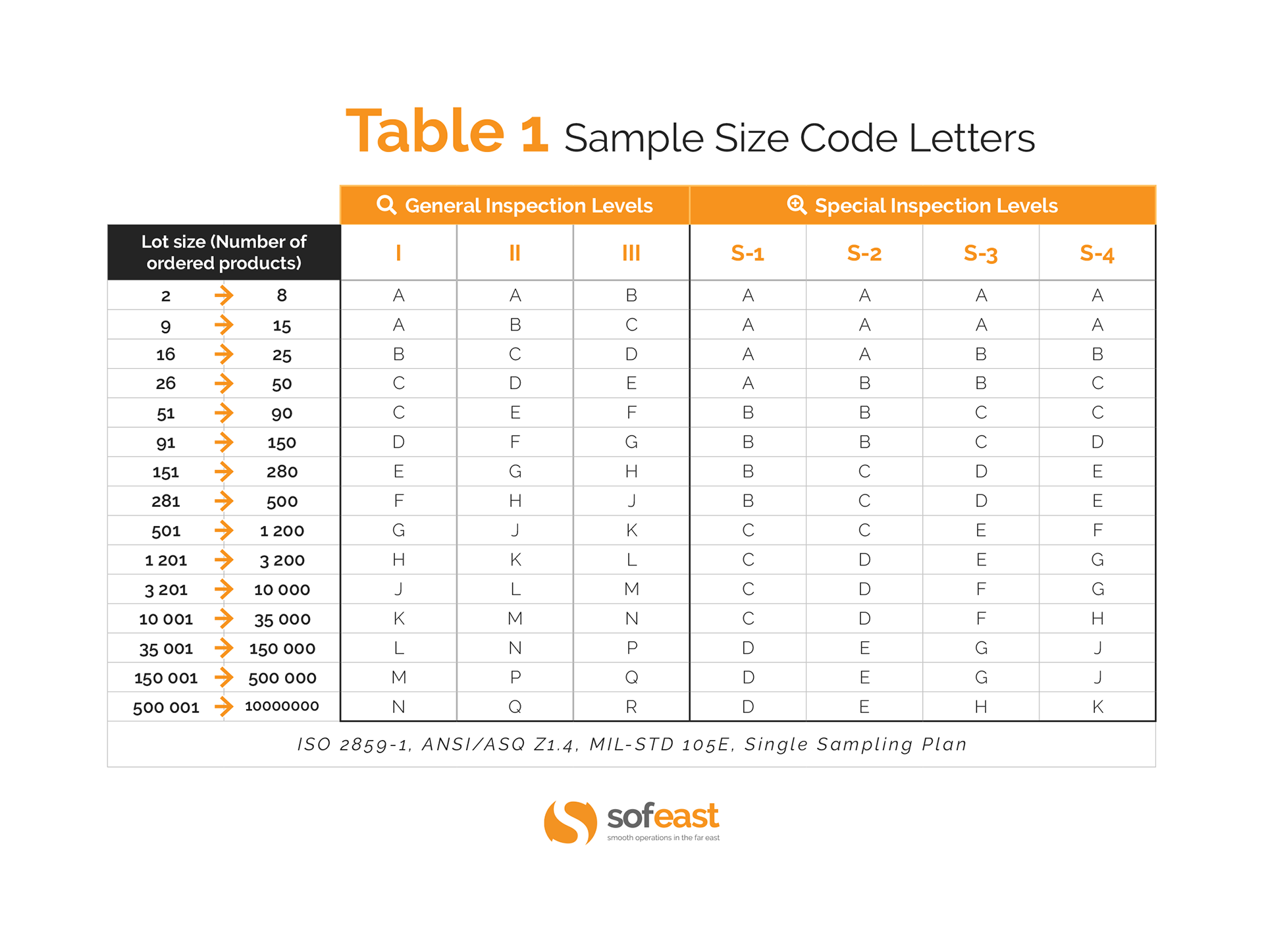
Let’s examine the more general inspection levels as seen in AQL table 1, and when they’d be appropriate for use:
Level I
Has this supplier passed most previous inspections? Do you feel confident in their products’ quality? Instead of doing no quality control, buyers can check fewer samples by opting for a level-I inspection.
However, settling on this level by default, in order to spend less time/money on inspections, is very risky. The likelihood of finding quality problems is lower than generally recommended.
Level II
It is the most widely used inspection level, to be used by default.
Level III
If a supplier recently had quality problems, this level is appropriate. More samples are inspected, and a batch of products will (most probably) be rejected if it is below the quality criteria defined by the buyer.
Some buyers opt for level-III inspections for high-value products. It can also be interesting for small quantities, where the inspection would take only one day whatever level is chosen.
The 4 “special” inspection levels
Also found in AQL table 1, these special levels can be applied in cases where only very few samples can be checked. “Four additional special levels, S-1, S-2, S-3 and S-4 […] may be used where relatively small sample sizes are necessary and larger sampling risks can be tolerated” (ISO 2859-1 standard).
Under S-3 level, the number of samples to check is lower than under S-4, and so on.
In practice: for consumer goods, visual quality control (i.e. checking the appearance of the products, their basic function…) is usually performed under the general levels.
The special levels are typically used for certain tests that either take lots of time or destroy the samples. Another situation where special levels are appropriate is during container-loading supervision – to have an idea of what is inside the cartons without spending too much time on the inspection.
Read more anout AQL: https://www.gis-inspection.com/post/how-to-use-aql-for-quality-control-inspection
4 Key Parameters of ISO 2859-1 AQL Sampling Plans
1. The ‘lot size’
Lot size is defined as the item in a lot in ISO 2859. If you ordered different products, consider each product as a separate lot. (The quantity of each product is the lot size). If you ordered only one product, the lot size is the total batch quantity.
2. The inspection level
The inspection level determines the relative amount of inspection in relation to the lot size. ISO 2859-1 uses General Inspection Levels I, II and III, as well as special inspection levels S-1 through S-4.
- Level I — smaller sample size and lower inspection effort
- Level II — commonly used for general product inspections
- Level III — larger sample size and greater discrimination
- S-1 to S-4 — special levels used when relatively small sample sizes are appropriate
For many commercial product inspections, General Inspection Level II is commonly specified. However, the appropriate level should be determined by the buyer's quality requirements and the purpose of the inspection rather than automatically selecting Level II.
3. The AQL limits
Quality level that is the worst tolerable process average when a continuing series of lots is submitted for acceptance sampling. The AQL limits appropriate for your market. If your customers accept very few defects, you might want to set a lower AQL for both major and minor defects.
For example, a buyer might specify:
|
Defect Classification |
AQL |
|
Critical |
0 |
|
Major |
2.5 |
|
Minor |
4.0 |
Different AQL values can therefore be assigned to different defect classifications.
The actual acceptance decision still depends on the sample size and acceptance number specified by the applicable sampling plan.
4. AQL defects
Usually in production quality control defects are classified in three types: Critical, Major and Minor.
|
Defect Category |
Definition |
Typical Examples |
|
Critical Defect |
A defect that may create a safety hazard, violate mandatory regulations, or make the product unsafe for use. |
Exposed live electrical parts, dangerous sharp edges, incorrect safety labeling |
|
Major Defect |
A defect that significantly affects the product's function, performance, durability, appearance, or intended use. |
Product does not function, broken component, serious assembly error, significant dimensional deviation |
|
Minor Defect |
A defect that does not significantly affect functionality or usability but deviates from the agreed specification or quality standard. |
Minor scratches, slight cosmetic imperfections, small stitching irregularities |
It is important to note that AQL 2.5 does not mean that 2.5% of products are automatically acceptable. AQL is a parameter used to select an acceptance sampling plan; the actual pass/fail decision is based on the sample size and the corresponding Ac/Re numbers.
ISO 2859-1 Standards and National Equivalents Around the World
ISO 2859-1 is the international reference for AQL-based acceptance sampling, but buyers and suppliers may encounter different national standard numbers depending on the market. Many countries have adopted ISO 2859-1 directly or published national standards based on the same sampling principles.
|
Country / Region |
National or Regional Standard |
Relationship / Notes |
|
International |
ISO 2859-1:2026 |
International reference standard for AQL-based lot-by-lot acceptance sampling |
|
United States |
ANSI/ASQ Z1.4 |
Widely used U.S. standard for sampling procedures and tables for inspection by attributes |
|
China |
GB/T 2828.1 |
Chinese national standard corresponding to the ISO 2859-1 sampling system |
|
Japan |
JIS Z 9015-1 |
Japanese standard based on ISO 2859-1 |
|
United Kingdom |
BS ISO 2859-1 |
British adoption of the ISO standard |
|
Australia |
AS 1199.1 |
National standard historically corresponding to ISO 2859-1 |
ISO 2859-1 vs. ANSI/ASQ Z1.4: What Is the Difference?
ISO 2859-1 and ANSI/ASQ Z1.4 are two widely used standards for acceptance sampling by attributes. The main difference is where the standards are developed and specified for use. ISO 2859-1 is an international standard, while ANSI/ASQ Z1.4 is the U.S. national standard maintained through the ANSI/ASQ standards system.
|
Feature |
ISO 2859-1 |
ANSI/ASQ Z1.4 |
|
Standard body |
International Organization for Standardization (ISO) |
ANSI / ASQ |
|
Primary use |
International supply chains and global quality control |
U.S. market and organizations specifying U.S. standards |
|
Inspection type |
Inspection by attributes |
Inspection by attributes |
|
Sampling basis |
AQL |
AQL |
|
Sampling plans |
Single, double and multiple sampling |
Single, double and multiple sampling |
|
Inspection severity |
Normal, tightened and reduced |
Normal, tightened and reduced |
|
Switching rules |
Yes |
Yes |
|
Historical background |
Part of the ISO 2859 family derived from earlier acceptance-sampling systems |
Direct lineage to MIL-STD-105E |
|
Current edition |
ISO 2859-1:2026 |
ANSI/ASQ Z1.4-2003 (R2018), according to ASQ |
Conclusion
ISO 2859-1 has been used for decades as a practical framework for acceptance sampling, and the 2026 revision reflects the standard’s continued development to meet modern quality management needs. While manufacturing technology and quality control methods continue to evolve, the fundamental challenge remains: how can buyers make a reliable, statistically based quality decision about a large production lot without inspecting every unit?
ISO 2859-1 does not guarantee that a shipment will be completely free of defects. Instead, it provides a consistent and internationally recognized approach to acceptance sampling, helping buyers define quality requirements, evaluate product conformity, and manage the risks associated with large-volume production.
For importers and sourcing companies, using a clearly defined sampling standard can also reduce misunderstandings between buyers, suppliers, and inspection companies. When the lot size, inspection level, AQL, defect classification, and acceptance criteria are agreed in advance, inspection results become more transparent and actionable.
GIS Inspection provides third-party product inspection services based on ISO 2859-1/ ANSI/ASQ Z1.4 sampling protocols for a wide range of products and manufacturing regions across China and Asia. Our inspection reports document the applicable sampling plan, sample size, AQL requirements, defect classifications, inspection findings, and supporting photos and test results—giving buyers the information they need to make informed shipment decisions.