

"We only have 180 units in this lot. Should we still inspect according to our usual AQL table?"
For cross-border e-commerce, small and frequent orders are becoming increasingly common. Instead of placing one large order of several thousand units, buyers may place several orders of a few hundred units, often with multiple SKUs, colors, and sizes.
This raises an important question: Should small orders still be inspected using the same AQL approach as large production lots?
AQL remains an established sampling method, but small-batch inspection should not be reduced to simply applying a fixed sampling percentage. A more effective approach combines sampling, product risk, SKU coverage, supplier performance, and delivery requirements.
Chapter 1. Is AQL Still Suitable for Small-Batch Orders?
AQL sampling is widely used for quality control and acceptance sampling. However, it should be treated as a sampling methodology, rather than a fixed inspection percentage.
ISO 2859-1:2026 defines a system of acceptance sampling plans for inspection by attributes, introduces skip-lot sampling procedures, updated guidance for applying sampling strategies.
For small orders, the key question is not simply how many units to inspect. It is whether the inspection plan provides sufficient coverage of the risks that matter most to the buyer.
Professional inspection companies such as General Inspection Services (GIS Inspection) uses inspection programs that can be adapted to production volume, product requirements, quality risks, and buyer-specific quality control plans.
For this reason, a small order should not automatically be treated as a miniature version of a large production lot.
Chapter 2. What Should Be Checked in a 200- or 300-Piece Order?
Consider a typical e-commerce order of 300 household products. The order includes several colors and sizes, and the supplier needs to ship within 24–48 hours.
A conventional approach might simply apply an AQL sampling plan to the total quantity.However, this can create a coverage problem.
For example, if one color accounts for only 30 pieces of the order, a general random sample may include very few—or none—of those units. Yet that particular color may be the customer's best-selling SKU. The inspection should therefore consider more than the total lot size.
A practical inspection plan can include:
- SKU and quantity verification
- Appearance and workmanship
- Dimensions and specifications
- Function and performance
- Materials and components
- Packaging and labeling
- Barcode and carton markings
- Key accessories and product completeness
- Buyer-specific requirements
The objective is to ensure that high-risk products and critical requirements receive adequate coverage, even when the overall order quantity is small.
Chapter 3. Use a Risk-Based Approach for Small-Batch Inspection
For small orders, a three operational tiers inspection strategy can be more practical.
Tiers 1. Critical Safety and Functional Requirements
Safety-related and critical functional requirements should not be overlooked simply because the order is small.
Depending on the product, these may include:
- Electrical safety
- Power-on and functional testing
- Critical assembly
- Key components
- Safety warnings
- Labels and markings
- Barcode verification
- Product completeness
- Customer-specific requirements
Where practical, critical items may be subject to 100% verification. If full inspection is not feasible because testing is destructive, time-consuming, or costly, an appropriately increased sample or dedicated testing plan can be used.
Tiers 2. General Appearance and Workmanship
For attributes such as:
- Appearance
- Workmanship
- Surface finish
- Stitching
- Minor cosmetic defects
- Packaging condition
Sampling inspection can be applied based on the lot size, product risk, specifications, and supplier quality history.
The important point is that AQL does not mean inspecting a fixed percentage of every order. An AQL system defines a sampling plan and acceptance criteria for a particular inspection situation.
Tiers 3. Supplier Quality History
Supplier performance should also influence the inspection strategy. If a supplier has consistently delivered conforming products over many consecutive shipments, the buyer may be able to optimize inspection coverage for lower-risk characteristics. Conversely, repeated defects should trigger closer monitoring, additional sampling, or more extensive inspection.
GIS Inspection describes vendor inspection as a means of identifying quality issues early and taking corrective action before shipment.
Chapter 4. A Practical Inspection Model for Small Orders
Instead of specifying only “AQL 2.5 / 4.0,” buyers can consider four factors:
Order quantity × Product risk × Supplier history × Delivery requirements
|
Situation |
Recommended approach |
|
100–300 units, new supplier |
Critical items checked extensively + focused sampling |
|
100–300 units, established supplier |
Critical checks + risk-based sampling |
|
300–1,000 units, new product |
Increased coverage of new-product risks |
|
Stable supplier with consistent quality |
Optimize inspection based on historical performance |
|
Repeated major defects |
Increase inspection intensity and investigate root causes |
|
High-value or high-return-risk products |
Prioritize risk coverage rather than minimizing inspection cost |
This approach is consistent with the broader quality assurance principle used by major inspection organizations: inspection programs should be tailored to the buyer's requirements and the specific characteristics of the supply chain.
GIS Inspection, for example, states that its inspection methods can be customized according to buyer-specific quality control plans and can be applied even to small and region-specific production volumes.
Chapter 5. Case Study: Mitigating Defect Risk in a Multi-SKU Shipment
A global home decor brand faced operational friction in South China as order volumes per SKU dropped while overall variant counts increased. A recent consolidation shipment totaled 300 units split across multiple dimensions and finishes.
Applying standard general inspection levels across the total volume yielded insufficient coverage for smaller SKU runs.
Rather than applying a generic sampling percentage, the quality plan stratified inspection criteria:
- High-Risk Items (100% Verification): Barcode accuracy, shipping mark compliance, packaging specs, and accessory verification across all SKUs.
- Workmanship & Aesthetics: Sampled using General Inspection Level II.
- Functional & Dimensional Checks: Evaluated using Special Inspection Levels ($S-3$).
During inspection, inspectors identified an incorrect accessory configuration in a minor SKU variant accounting for under 10% of total shipment volume. Standard lot-level random sampling would likely have missed the defect.
Stratifying the inspection by SKU risk caught the error on-site, allowing the factory to rework the batch the same day without missing the ocean freight booking.
Chapter 6. Inspection Speed Matters for Small Orders
Small-batch e-commerce is often driven by short production cycles and rapid replenishment. A factory may complete an order today and load the goods the following day.
This means inspection speed becomes part of the quality control process.
A practical workflow can be:
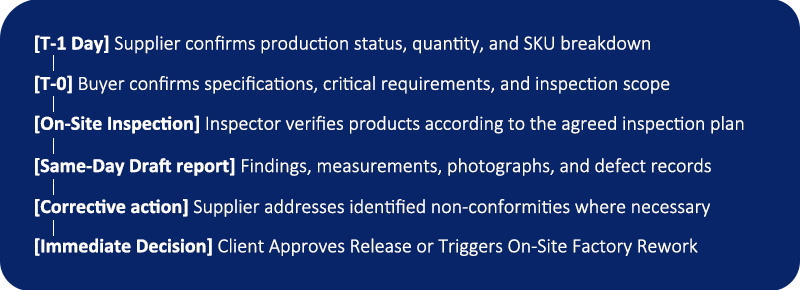
This type of on-site verification allows buyers to identify non-conformities before goods leave the factory. GIS Inspection highlights the value of identifying corrective actions before completion of a consignment.
Chapter 7. A “Pass” Report Should Not Be the End of Quality Management
For businesses placing dozens or hundreds of small orders each year, inspection reports can provide valuable supplier performance data.
Instead of treating each report as an isolated PASS/FAIL result, buyers can monitor:
- Major defect frequency
- Critical defect frequency
- Recurring defects
- Rework frequency
- Corrective action performance
- SKU-specific quality problems
- Quality trends by supplier
- Quality performance over the previous 6–12 months
This information can support future supplier decisions.
A supplier with stable performance may require a more focused inspection strategy, while a supplier with recurring defects may need increased inspection, a factory audit, or corrective action follow-up.
GIS Inspection similarly positions vendor assessment and inspection as tools for evaluating supplier capability, competence, quality, and compliance.
8. Small-Batch Inspection Is About Risk, Not Just Sample Size
Small orders do not necessarily require the highest possible sampling rate. Instead, the inspection plan should focus on the risks that could have the greatest impact on the buyer.
Three principles are particularly useful:
- A smaller order does not mean that critical requirements can be ignored.
- The more SKUs an order contains, the more important SKU-level coverage becomes.
- Supplier quality history should influence future inspection strategies.
For e-commerce buyers, the goal is not simply to inspect a certain percentage of the shipment. It is to use an appropriate inspection method to identify the defects most likely to affect product performance, customer satisfaction, compliance, and delivery.
Conclusion: Adapt the Inspection Plan to the Order
AQL remains an important tool for acceptance sampling, but it should not become a rigid inspection template.
For small and frequently replenished orders, an effective quality control program combines AQL sampling where appropriate, critical-item verification, SKU coverage, supplier performance data, and production-stage inspection.
The right question is therefore not:
“How many units should we inspect?”
It is:
“What level of inspection will give us sufficient confidence that the products we are about to ship meet the agreed requirements?”
For small-batch sourcing, this risk-based approach can help buyers control inspection costs while maintaining effective oversight of product quality and supplier performance.
GIS Inspection
GIS Inspection (General Inspection Services), established in 2005 and headquartered in China, is an CNAS 17020, ISO 9001, and AQSIQ accredited third-party agency. We specialize in comprehensive quality control inspection and supply chain solutions for global buyers. By deploying a dedicated team of 100% full-time professional inspectors, GIS Inspection ensures peak integrity and technical consistency. Today, we are the trusted quality partner for over 12,000 global brands.
Email: lisaliu@gis-inspection.com