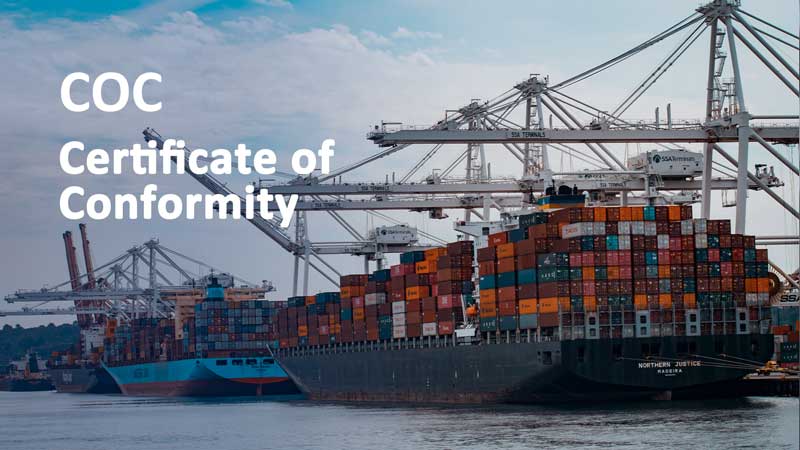
When importing products, a Certificate of Conformity (COC) is a crucial document that ensures your goods meet official standards and cross-border trade regulations. Whether you are a manufacturer, importer, or retailer, understanding the importance of a Certificate of Conformity is crucial for ensuring compliance and avoiding regulatory penalties.
Content
What is a Certificate of Conformity?
Why does Certificate of Conformity Matters?
When Do You Need a Certificate of Conformity?
How to Obtain a Certificate of Conformity?
Example of obtaining a Certificate of Conformity (COC) for motor vehicles
Key Elements that a CoC include
What is a Certificate of Conformity?
A Certificate of Conformity is an official document issued by a third-party laboratory, manufacturer, or importer. It verifies that a product complies with applicable safety, performance, and regulatory standards.
The standards can be set by a number of different bodies, such as the European Union (EU), the Gulf Cooperation Council (GCC), the Saudi Standards, Metrology and Quality Organization (SASO), or other country-specific regulatory agencies.
Issued by the manufacturer or by an authorized third-party body, it is the documentary proof that customs authorities, retailers, and buyers rely on to confirm a shipment is compliant before it crosses a border.
Why does Certificate of Conformity Matters?
- Ensures Regulatory Compliance
A CoC confirms that products meet the required safety, quality, and regulatory standards for the target market. - Simplifies Customs Clearance
Many countries require a CoC for import. It helps prevent customs delays and facilitates smooth clearance. - Builds Customer Confidence
A CoC demonstrates that products have been tested and verified, increasing trust in their safety and quality. - Provides Legal Proof of Compliance
A CoC serves as official documentation that products comply with applicable regulations, helping reduce legal and compliance risks.
When Do You Need a Certificate of Conformity?
You generally need a CoC whenever the destination market makes it a condition of import or sale. Requirements fall into two groups:
- Mandatory CoC — required by law before goods can clear customs. Examples include G-Mark certification for the Gulf Cooperation Council, and SABER and SASO certification for Saudi Arabia.
- Voluntary CoC — obtained by the manufacturer to demonstrate product quality and build buyer trust, even when it is not legally required.
A pre-shipment inspection is a practical way to confirm your goods actually match the specifications a certificate of conformity certifies — before they leave the factory, and before a non-conformity is discovered at the border.
How to Obtain a Certificate of Conformity
Specific procedures and requirements for obtaining a COC may vary depending on the manufacturer, the Products' origin, and the destination country's regulations. Obtaining a Certificate of Conformity involves 4 key steps:
Step 1: Identify Relevant Standards
Determine the specific standards and consumer product safety rules that apply to your product. These may vary based on the region and industry.
Step 2: Testing and Verification
Engage a third-party laboratory to conduct testing and ensure that the product meets the requirements. These labs conduct rigorous testing to verify compliance with applicable safety and regulatory standards.
Step 3: Documentation
Compile all necessary documentation, including test results, manufacturing details, and compliance declarations. This is critical for certifying compliance of the product.
Step 4: Issuance of the Certificate
Once all requirements are met, the responsible entity, such as the manufacturer or importer, issues the Certificate of Conformity. Ensure that it includes all required details, such as the address and telephone number of the responsible parties.
Example of obtaining a Certificate of Conformity (COC) for Motor Vehicles
To obtain a Certificate of Conformity (COC) for a vehicle, follow these general steps:
- Contact the right authorities: Reach out to the manufacturer or their representative to request a COC for the specific vehicle. You can also use some of the popular online services like EUROCOC.
- Provide necessary information: You'll likely need to provide details such as the Vehicle Identification Number (VIN), and any other requested information, most likely vehicle make, model, and variant.
- Submit required documentation: Depending on the manufacturer's requirements and the vehicle's history, you may need to submit additional documentation, such as proof of ownership or purchase.
- Pay any applicable fees: Some manufacturers may charge a fee for issuing the COC.
- Receive the COC: Once the manufacturer or their representative verifies the vehicle's compliance, they will issue the COC. This document contains all the information confirming the vehicle's conformity to regulatory standards.
- Use the COC for registration or importation: With the COC, you can proceed with vehicle registration within the EU or import the vehicle into countries that recognize or require COCs for compliance purposes - like Portugal or Italy.
Key Elements that a CoC include
The contents of a CofC can vary from manufacturer to manufacturer, as it is dependent upon the type of scale, applicable use and the certifications they possess. Some manufacturers include more information than others. They vary depending upon the applicable industry and the quality guidelines they follow. A properly documented Certificate of Conformity includes:
- Product identification: Description of the product covered in the CoC
- List of all safety regulations the product must pass: The CoC must clearly list each of the safety regulations the product must be tested for, refer to related tests reports or certificates
- Importer or manufacturer’s identification: Provide the name, full mailing address, and telephone number of the importer or domestic manufacturer certifying the product
- Contact information for the individual maintaining records of test results: Provide the name, full mailing address, e-mail address, and telephone number of the person maintaining test records in support of the certification.
- Date and place where the product was manufactured: the month and year should be shown and the city, state, and country needs to be shown.
- Provide the date(s) and place when the product was tested for compliance with the consumer product safety rule(s) cited above: Provide the location(s) of the testing and the date(s) of the test(s) or test report(s) on which certification is being based.
- Identification of any third-party laboratory on who’s testing the certificate depends: Provide the name, full mailing address, and telephone number of the third-party laboratory.
GCC for Importing Consumer Goods into the USA
If you manufacture or import consumer products into the United States, you may be required to provide a General Certificate of Conformity (GCC). A General Certificate of Conformity (GCC) is a written document certifying that a general-use consumer product complies with all applicable U.S. consumer product safety regulations.
Elements Required in a GCC:
- Identification of the product covered by this certificate
- Citation to each CPSC product safety rule to which this product is being certified
- Identification of the domestic manufacturer or importer certifying compliance of the product
- Contact information for the individual maintaining records of test results
- Date and place of manufacture
- Date(s) and place(s) of testing
- Identification of any third-party laboratory who conducted the testing
GCC Example – Mattress
On the US CPSC (Consumer Product Safety Commission) website, one can find several samples of CoCs. Here is one example.
In this example, while the mattresses were not required to be tested by a third party laboratory, the mattress manufacturer voluntarily chose to do so and must provide the information about that laboratory.
- Identification of the product covered by this certificate:
Luxe Mattress Models #456, 789 (Queen, King)
Citation to each CPSC product safety regulation to which this product is being certified: 16 CFR Part 1632, Standard for the Flammability of Mattresses and Mattress Pads16 CFR Part 1633, Standard for the Flammability (Open Flame) of Mattress SetsIn this example, the two standards for mattress flammability are the only applicable requirements.
- Identification of the importer or domestic manufacturer certifying compliance of the product:
MattressSafety USA Importers
123 Good Sleep Way
Springfield, MA 12345
(549) 456-7890
- Contact information for the individual maintaining records of test results:
Mary Smith, Compliance and Quality Control
MattressSafety USA Importers
123 Good Sleep Way
Springfield, MA 12345
(549) 456-7890 ext. 99, mary@mattressafety101.net
- Date and place where this product was manufactured:
May 2011, Guangzhou, China
Date and place where this product was tested for compliance with the regulation(s) cited above: June 2011
Guangzhou, China. General use (non-children’s) products must be subjected to actual testing or a reasonable testing program and do not require testing by an accredited, third party laboratory accepted by the CPSC.
- Identification of an accredited laboratory accepted by the CPSC on whose testing the certificate depends:
Guangzhou Quality Labs
No. 023 Shi Nan Road
Dong Zhou, Pan Zi
Guangzhou City
Guangdong Province, China. 511453
+(86) 20 09 7723 5467
EU Declaration of Conformity
An EU declaration of conformity (DoC) is a mandatory legal document that you as a manufacturer (or your authorized representative) must sign to declare that your products comply with all EU requirements.
The EU declaration of conformity declaration of conformity must contain the following information:
- your name and full business address or that of your authorised representative
- the product's serial number, model or type identification
- a statement, stating you take full responsibility
- means of identification of product allowing traceability – this can include an image
- the details of the notified body which carried out the conformity assessment procedure (if applicable)
- the relevant legislation with which the product complies, as well as any harmonised standards or other means used to prove compliance
- your name and signature
- the date the declaration was issued
Certificate of Compliance vs. Certificate of Conformity
There is sometimes confusion between the two terms, however, in most cases, these two terms mean exactly the same thing and often comes down to the personal preference of the company that needs the certificate.
For example, American national standard ASQ/ANSI ID1:2021 defines a “Certificate of Compliance” as “a document from an authority certifying that the supplied products or services conform to specific and required specifications. It may also be called a certificate of conformance or certificate of conformity.”
FAQs
Q1: What is a Certificate of Conformity (CoC)?
A document issued by an authorized party (manufacturer or accredited lab) stating a product meets specified standards or regulations.
Q2: Who issues the CoC, factory or third party?
Depending on the market and product, a CoC may be issued by the manufacturer or by an authorized third-party conformity assessment body. For regulated markets such as Saudi Arabia (SABER/SASO) or the GCC (G-Mark), an approved body issues the certificate after reviewing the product test reports and technical documentation.
Q3: Does every country require a CoC?
Requirements vary by market and category. Always confirm destination-market rules and the exact document name required.
Q4: What information should a CoC contain?
Product identification, applicable standards/regulations, issuing party, date, and references to supporting evidence such as test reports.
Q5: Is a CoC enough for market access?
Usually not. You’ll also need a technical file, correct labeling, and other documents depending on the product and market.
Q6. Is a certificate of conformity mandatory?
It depends on the destination country and product type. Mandatory CoCs are required by law for goods to clear customs — for example, Nigeria (SONCAP) requires a CoC prior to shipment to prevent substandard goods from entering the market.
GIS Inspection
GIS Inspection (General Inspection Services), established in 2005 and headquartered in China, is an CNAS 17020, ISO 9001, and AQSIQ accredited third-party agency. We specialize in comprehensive quality control inspection and supply chain solutions for global buyers. By deploying a dedicated team of 100% full-time professional inspectors, GIS Inspection ensures peak integrity and technical consistency. Today, we are the trusted quality partner for over 12,000 global brands.
Email: lisaliu@gis-inspection.com