
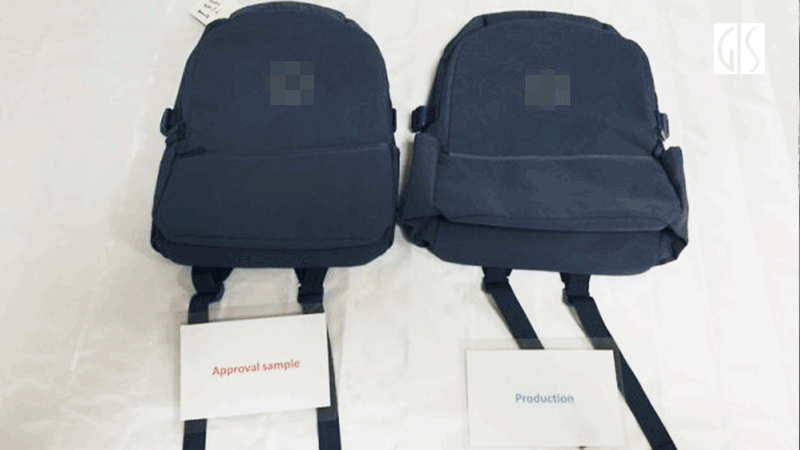
 GIS Inspection conducts a third-party backpack inspection before shipment, helping buyers reduce quality risks and ensure compliance with customer specifications.
Bag inspection is a quality control process that verifies bags meet approved specifications, workmanship, functionality, labeling, and packaging requirements before shipment. It helps importers, retailers, and brands identify defects early, reduce returns, and ensure consistent product quality.
From backpacks and handbags to travel luggage and tote bags, manufacturers use a variety of materials—including canvas, polyester, nylon, leather, PU leather, cotton, and recycled fabrics—along with functional components such as zippers, buckles, wheels, and metal hardware.
To ensure every product meets buyer specifications for quality, workmanship, functionality, and safety, bag inspections are commonly conducted during production (DUPRO), pre-shipment inspections (PSI), or by independent third-party inspection companies before shipment.
Content
Why Bag Inspection is Important?
Bags experience repeated loading, lifting, carrying, folding, and abrasion during normal use. Poor manufacturing quality can result in damaged seams, broken zippers, detached handles, color inconsistencies, or structural failure after only limited use.
Quality inspection helps buyers identify manufacturing defects before shipment, reducing the risk of customer complaints, product returns, warranty claims, and retailer rejection.
Bag inspections commonly help verify:
- Material quality
- Stitching consistency
- Assembly quality
- Functional performance
- Hardware durability
- Logo accuracy
- Packaging quality
- Quantity verification
- Labeling compliance
For importers sourcing from multiple factories, independent inspection also provides consistent quality evaluation across suppliers.
Bag Quality Control Inspection Checklist
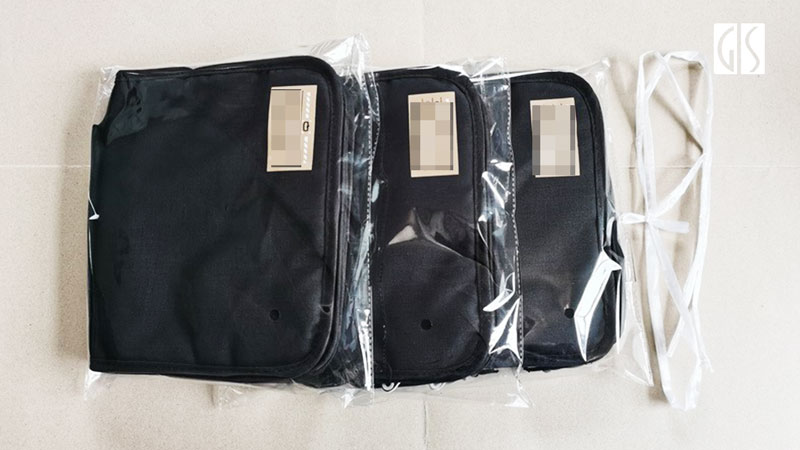
A GIS Inspection quality inspector verifies backpack packaging during a pre-shipment inspection to ensure compliance with buyer specifications before shipment.
Inspection procedures are typically based on approved samples, technical specifications, purchase orders, product drawings, packaging artwork, and buyer requirements.
1. Workmanship and Visual Check
Visual inspection evaluates the overall appearance and manufacturing quality of the finished product.
Typical inspection points include:
- Fabric defects
- Surface stains
- Dirt or contamination
- Incorrect color
- Color shading differences
- Loose threads
- Uneven stitching
- Skipped stitches
- Open seams
- Wrinkles
- Scratches
- Glue residue
- Printing defects
- Embroidery quality
- Logo accuracy
- Edge finishing
- Material damage
Inspectors also compare products against approved reference samples to verify appearance consistency.
2. Material and Component Verification
Bag quality depends heavily on the consistency of materials and accessories used during production.
Inspection items commonly include:
- Fabric type
- Material thickness
- Fabric texture
- PU or leather appearance
- Lining quality
- Webbing material
- Foam padding
- Metal hardware finish
- Plastic component quality
- Buckle condition
- Hook quality
- Wheel condition
- Handle material
- Reinforcement patches
Material substitutions are a common concern during production and are typically verified during inspection.
3. Dimension Verification
Measurements are checked against approved specifications.
Typical verification includes:
- Overall dimensions
- Handle length
- Strap width
- Pocket dimensions
- Weight
- Capacity
- Logo position
- Label placement
- Carton dimensions
Measurement tolerances should comply with buyer specifications.
4. Function Check for Bag
Functional testing verifies that all moving parts and carrying components operate correctly.
Typical functional checks include:
- Zipper operation
- Buckle locking
- Snap button function
- Velcro adhesion
- Strap adjustment
- Shoulder strap attachment
- Handle strength
- Wheel rolling
- Telescopic handle extension
- Pocket functionality
- Closure performance
- Foldability
- Carrying comfort
Repeated operation testing helps identify weak assembly or poor-quality components.
5. On-site Tests Commonly Performed for Bag Inspection
|
Depending on the product type and buyer requirements, inspectors may perform additional functional evaluations to ensure product quality and durability. Zipper Durability TestZippers are repeatedly opened and closed to verify:
Strap Strength CheckShoulder straps and carrying handles are evaluated for secure attachment and resistance to separation under normal handling. |
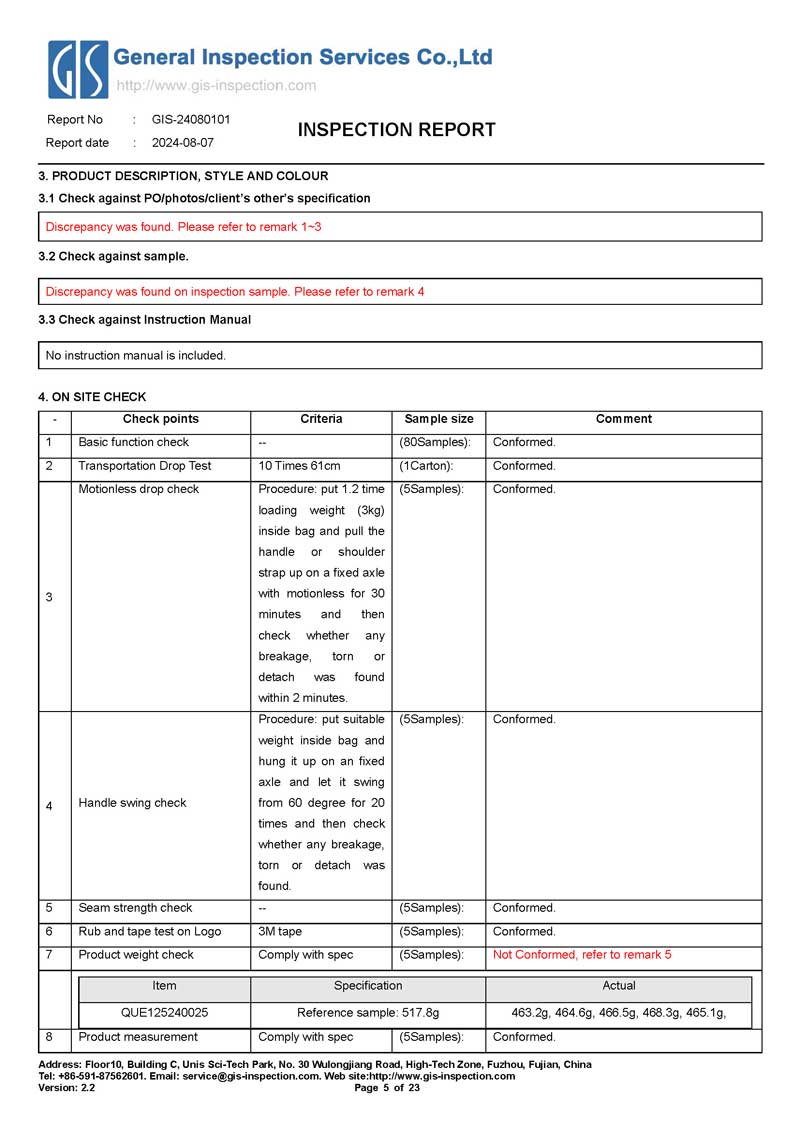
Figure: GIS on-site inspection for bag products |
Handle Strength Check
The handle's attachment to the luggage body is tested by applying a gradually increasing tensile force until separation occurs or until a pre-set load is maintained for a specified time.
Handle Snatch Check
Handles are subjected to a sudden pulling force to evaluate their attachment strength and ensure they do not detach or become damaged during normal use.
Wheel Rolling Check
Wheels are tested for smooth rolling, proper alignment, and stable operation to ensure reliable mobility without excessive noise, wobbling, or jamming.
Telescope Handle Check
To verify the telescopic handle's mechanical endurance and locking reliability after repeated extension and retraction cycles.
Barcode Check
A visual and functional inspection of all barcodes, labels, and markings on the product and packaging.
Transportation Drop
The packaged product is subjected to a drop test to evaluate whether the bag and its packaging can withstand normal transportation impacts without functional damage or significant defects.
6. Packaging and Labeling Inspection
Packaging inspection verifies whether products are correctly packed for shipment and retail distribution.
Common checkpoints include:
- Barcode verification
- Hangtag accuracy
- Care label inspection
- Country of origin marking
- Polybag condition
- Carton quality
- Shipping marks
- Quantity verification
- Assortment confirmation
- Retail packaging appearance
Incorrect labeling or packaging can result in shipment delays or retailer rejection.
Common Defects for Bag Inspection
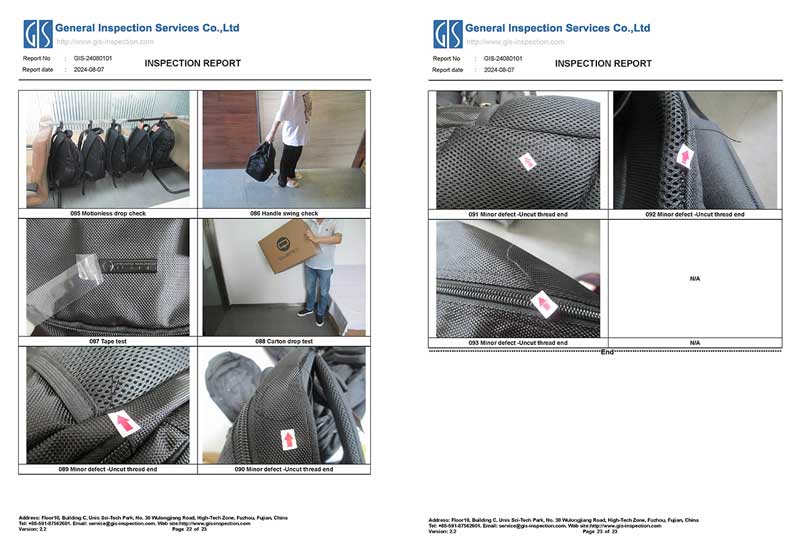
During a third-party bag inspection, GIS Inspection detects broken stitch defects to ensure bags meet buyer specifications, workmanship standards, and quality requirements before shipment.
The following defects are frequently identified during bag inspections.
|
Description |
|
|
Open Seam |
Stitching has separated |
|
Loose Stitching |
Weak seam construction |
|
Broken Zipper |
Zipper cannot operate smoothly |
|
Missing Accessories |
Buckles, hooks, or pulls missing |
|
Scratched Hardware |
Damaged metal components |
|
Fabric Stain |
Dirt, oil, or ink marks |
|
Color Variation |
Different fabric shades |
|
Incorrect Dimensions |
Product outside specified tolerance |
|
Crooked Logo |
Misaligned printing or embroidery |
|
Handle Misalignment |
Uneven attachment |
|
Glue Residue |
Excess adhesive visible |
|
Broken Buckle |
Plastic component failure |
|
Torn Lining |
Internal fabric damage |
|
Packaging Damage |
Crushed cartons or damaged polybags |
Defects are typically classified as critical, major, or minor according to the agreed inspection criteria.
Safety Standards for Bag Inspection
As luggage are not replaced that often, it is crucial for manufacturers to apply the standards sets by various organizations, agencies and independent laboratories to avoid any recalls and to ensure the safety and quality of its luggage.
EN Standards
EN standards can provide useful guidelines for the design of safe-to-use products and material quality. Here are some EN standards that may be useful for bag importers and manufacturers. Note that these EN standards don’t apply specifically to bags, but materials.
- EN 14362: Methods for determination of certain aromatic amines derived from azo colorants
- EN 16483: Labelling of leather trims in textile products
ASTM Standards
- ASTM D5552-10 – Standard Test Method for Resistance of Colored Leather to Bleeding
- F2153-07 – Standard Test Method for Measurement of Backpack Capacity
- ASTM F2057: Specifically for children’s clothing storage units, this standard establishes safety requirements to prevent tip-over hazards.
Recommended Quality Inspection Services for Bags
Based on the experience of third-party quality inspection companies, three types of inspection services are recommended for bags and luggage products:
1. Factory Audit
A Factory Audit is recommended before placing an order with a new supplier. Inspectors evaluate the factory's production capacity, quality management system, manufacturing processes, equipment, and compliance with social and environmental requirements.
This helps buyers assess whether the supplier is capable of consistently producing bags that meet quality expectations and delivery schedules.
2. Pre-Shipment Inspection (PSI)
Pre-Shipment Inspection is the most commonly used quality control service for bag products. It is typically conducted when at least 80%–100% of the order has been produced and at least 80% has been packed.
Inspectors perform random sampling based on the ANSI/ASQ Z1.4 (AQL) standard to verify product quantity, workmanship, dimensions, functionality, labeling, packaging, and overall quality before shipment.
Detecting defects before goods leave the factory helps reduce customer complaints, returns, and costly rework.
3. Container Loading Supervision (CLS)
Container Loading Supervision is the final quality control step before shipment. Inspectors monitor the loading process to verify the correct products and quantities are loaded into the container, confirm that cartons are handled properly, and ensure appropriate loading methods are used to prevent damage during transportation.
This service helps minimize shipping risks and ensures products arrive safely at their destination.
GIS BagS Quality Inspection Services
General Inspection Service (GIS Inspection) is a leading third-party quality control inspection company in China. With 20 years of industry-wide experience, GIS Inspection helps Christmas products businesses reduce supply chain risks, ensure product quality consistency.
GIS Quality Control Services for Bags
GIS Inspection offers comprehensive quality assurance services to luggage and backpack customers worldwide, including:
Quality Control Inspections
- Pre-Production Inspections
- During Production Inspections
- Pre-Shipment Inspections
- Container Loading Inspections
Learn more the details of: The 4 Types of Quality Inspection: A Complete Guide for Importers
Factory Inspection & Supplier Audit
GIS performs the following types of factory and supplier audits:
- Quality Assessment
- Social Compliance Audits
- Environmental Audits
- Manufacturer Audits
- Quality Engineering Consulting
Quality Assurance for E-commerce & Amazon FBA
GIS Inspection provides specialized quality assurance solutions for bags e-commerce sellers and Amazon FBA businesses, including:
- 100% Inspection
- Final Random Inspection
Bags Categories Covered by GIS Inspection
There are the main types of bags and luggage that GIS Inspection expertly inspects:
- Backpacks
- Handbags
- Pouches
- Wallets
- Purses
- laptop bags
- Tote Bags
- Trolley Bags
- Duffle Bags
- Suitcase
- Carry-on Luggage
- Garment Bags
- Hiking Backpacks
- Children’s Backpacks
Nationwide Christmas Product Inspection Coverage in China
GIS Inspection has developed a comprehensive nationwide office and inspection network across China, with local offices strategically located in key manufacturing regions, including Fuzhou, Guangzhou, Shenzhen, Dongguan, Shantou, Shanghai, Xiamen, Ningbo, Hangzhou, Suzhou, Jiangsu, Qingdao, Tianjin, Jinan, Zhengzhou, and Hong Kong.
Conclusion
Implementing a comprehensive bag inspection program is one of the most effective ways to ensure consistent product quality, reduce supply chain risks, and prevent costly defects from reaching customers.
By combining standardized inspection procedures with ANSI/ASQ Z1.4 (AQL) sampling, importers, retailers, brands, and manufacturers can verify that every shipment meets their quality requirements before export.
General Inspection Service (GIS Inspection) is a leading third-party quality control company in China with over 20 years of industry experience. Accredited by CAM, ISO 9001, CNAS ISO/IEC 17020, and AQSIQ, GIS provides professional factory audits, during production inspections, pre-shipment inspections, and container loading supervision for bags, luggage, backpacks, handbags, and other soft goods.
Contact GIS Inspection today to schedule your bag inspection and ensure your products are delivered on time and meet your quality expectations.
GIS Inspection
GIS Inspection (General Inspection Services), established in 2005 and headquartered in China, is an CNAS 17020, ISO 9001, and AQSIQ accredited third-party agency. We specialize in comprehensive quality control inspection and supply chain solutions for global buyers. By deploying a dedicated team of 100% full-time professional inspectors, GIS Inspection ensures peak integrity and technical consistency. Today, we are the trusted quality partner for over 12,000 global brands.
Email: lisaliu@gis-inspection.com